Will your current heating system survive the 2026 transition? With the UK government targeting 600,000 installations annually by 2028, the traditional gas boiler is quickly becoming a relic of the past. It’s stressful to watch energy bills climb while trying to decipher complex technical jargon. You need a heating solution that’s both sustainable and dependable. Installing an air heat pump isn’t just a green choice; it’s a strategic move to protect your wallet and your comfort. We’ve seen too many homeowners struggle with rising costs, and it’s time to take control with a system that actually works.
We understand the worry of a cold house in mid-winter. You want lower energy costs and a reduced carbon footprint without the headache of confusing paperwork. This guide cuts through the noise to explain exactly how an air heat pump functions in British weather. We’ll break down the 2026 grant landscape, including how to access the £7,500 Boiler Upgrade Scheme. You’ll learn how to swap your old boiler for a modern system that keeps your home warm and your bank balance healthy. Let’s future-proof your home with expert, reliable advice today.
Key Takeaways
- Understand why the air heat pump is becoming the new UK standard and how 2026 regulations will phase out traditional gas boilers.
- Learn the science behind extracting warmth from outdoor temperatures as low as -15°C to provide reliable, year-round comfort.
- Compare installation costs, maintenance needs, and lifespans to determine the long-term value of switching from a gas boiler.
- Identify the essential insulation and outdoor space requirements your property needs to ensure a successful and efficient transition.
- Discover how to access essential government grants through the 2026 Warm Homes Plan by using MCS-accredited installers.
What is an Air Heat Pump and Why is it the 2026 Standard?
An air heat pump is a low-carbon technology designed to replace traditional combustion-based boilers. Instead of burning gas or oil to create heat, this system extracts thermal energy from the outside air. It works like a refrigerator in reverse. It absorbs heat from the environment, compresses it to increase the temperature, and transfers it into your home. This shift from generating heat to moving heat makes the system incredibly efficient.
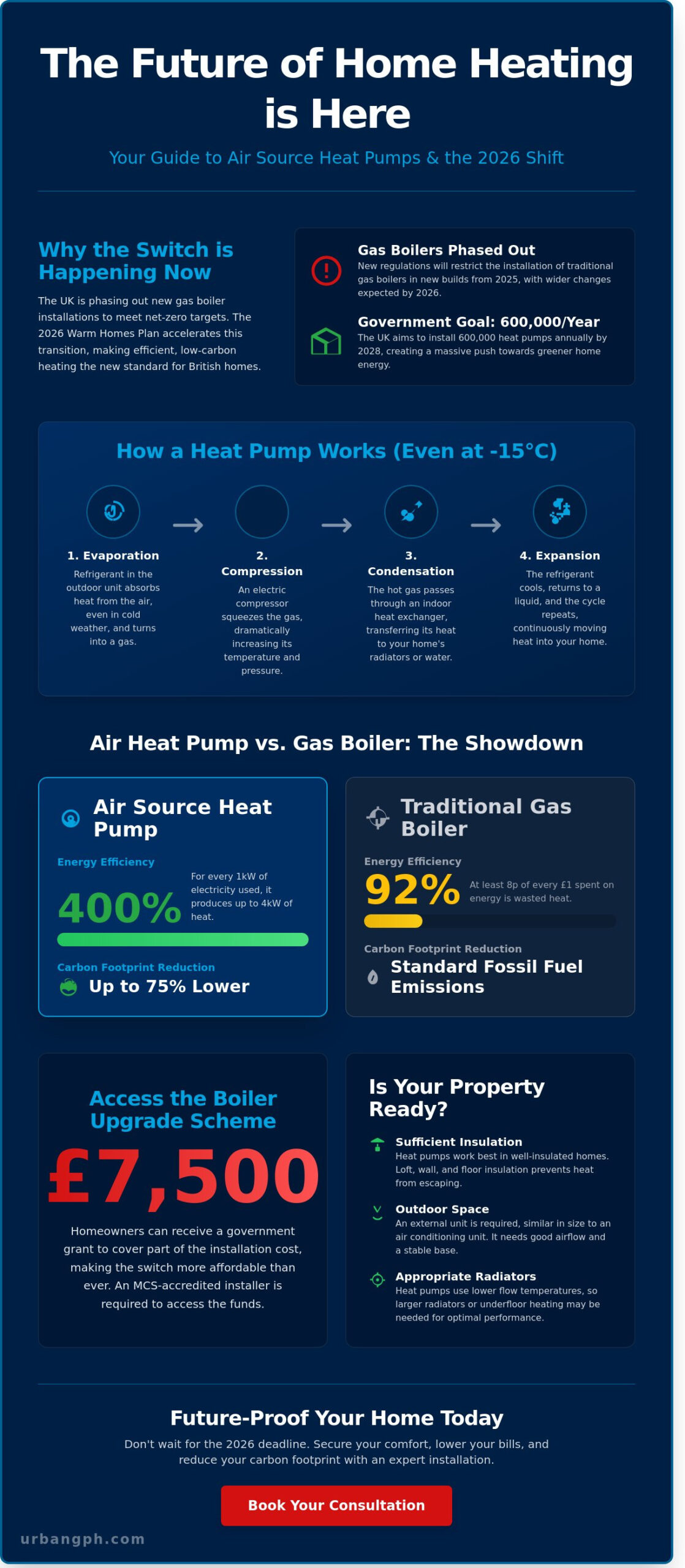
UK building regulations are changing rapidly to meet net-zero targets by 2050. The government has already signalled a phase-out of new gas boiler installations. For many homeowners, installing an air heat pump is now the primary solution for residential decarbonisation. It reduces carbon footprints by up to 75% compared to fossil fuel systems. Our team of expert engineers ensures these systems are installed and maintained to the highest safety standards, a commitment to technical excellence shared by industry veterans like RMI Heating and Air Conditioning. We provide the reliable service you need to stay warm while protecting the environment.
The Different Types of Air Source Systems
UK households typically choose between two main configurations. Air-to-water systems are the national standard for central heating. They connect directly to your radiators or underfloor heating and provide domestic hot water. Air to air heat pumps are often used for specific room heating or cooling, functioning much like an air conditioning unit. You must also choose between monobloc and split systems. A monobloc unit houses all components in a single outdoor box, saving indoor space. Split systems divide the components between an outdoor unit and an indoor heat exchanger, which is often better for properties with limited external wall space.
Why 2026 is the Pivotal Year for Heat Pumps
The year 2026 marks a major turning point for UK energy infrastructure. The 2026 Warm Homes Plan will accelerate the transition away from gas by providing enhanced support for renewable installations. National electricity grid improvements are scheduled for completion by this date, ensuring the network can handle the increased demand for electrified heating. This makes heat pumps more efficient as the grid becomes greener. Currently, the cost gap between gas and renewable energy is narrowing. With the Clean Heat Market Mechanism penalising boiler manufacturers who fail to meet low-carbon targets, electricity is becoming the smarter financial choice. We help you stay ahead of these regulations with professional servicing that keeps your system running at peak performance. Book a trusted engineer today to secure your home’s future.
How Air Heat Pumps Work: The Science of Heat Extraction
An air heat pump doesn’t create heat through combustion. It moves energy from one place to another. The outdoor unit contains a fan that pulls ambient air over a network of tubes filled with refrigerant. This liquid has a very low boiling point. Even when temperatures drop to -15°C, the refrigerant absorbs enough energy to turn into a gas. This is the fundamental science that makes the system so reliable for UK homes.
The system follows a specific four-stage cycle to provide warmth:
- Evaporation: The cold refrigerant absorbs outdoor heat and evaporates into a low-pressure gas.
- Compression: An electric compressor squeezes the gas. This rapidly increases its temperature and pressure.
- Condensation: The hot gas passes through a heat exchanger, transferring warmth to your home’s heating circuit.
- Expansion: The refrigerant passes through an expansion valve, cools down, and returns to liquid form to start again.
This process is measured by the Coefficient of Performance (COP). If a system has a COP of 4.0, it produces 4kW of heat for every 1kW of electricity consumed. Homeowners often wonder: Is an Air Source System Right for You? Government experts confirm that these units remain effective even during harsh UK winters. The outdoor unit acts as the heart of the system, constantly extracting energy to keep your property warm.
The Efficiency Advantage over Gas Boilers
Modern A-rated gas boilers operate at roughly 90% to 92% efficiency. This means at least 8p of every £1 spent is wasted. An air heat pump delivers 300% to 400% efficiency. Your Seasonal Coefficient of Performance (SCOP) tracks this average across the entire year, accounting for colder months. These systems use a low-flow temperature principle. Instead of scorching hot radiators, they provide a steady, consistent warmth that maintains a constant indoor climate. This approach reduces strain on the hardware and keeps energy bills predictable.
Integrating with Your Central Heating
The heat exchanger is the critical bridge between the outdoor unit and your radiators. For maximum efficiency, these systems require an “always-on” mindset. Short, high-intensity bursts of heat are inefficient for this technology. Reliable performance relies on the system running for longer periods at lower temperatures. Smart thermostats play a vital role here. They monitor outdoor conditions and adjust the flow temperature automatically. This ensures the system doesn’t work harder than necessary. If your system feels sluggish or your bills are rising, contact a trusted engineer to ensure your settings are fully optimised for the prevailing conditions.
Comparing Air Heat Pumps vs Traditional Gas Boilers
Switching from a gas boiler to an air heat pump requires a fundamental shift in how you manage home comfort. Gas boilers are often cheaper to install upfront, typically costing between £2,500 and £4,000 for a standard replacement. However, these units usually have a lifespan of 10 to 15 years. In contrast, a heat pump represents a larger initial investment, often ranging from £7,000 to £13,000 before government grants, but it offers a longer service life of up to 20 years. Beyond the finances, removing gas combustion from your property eliminates the risk of carbon monoxide leaks, making your home significantly safer.
The way these systems deliver warmth is the biggest change for homeowners. Combi boilers provide rapid, high-temperature bursts of heat that can warm a cold room in minutes. Heat pumps work on a low-and-slow principle. They maintain a steady, consistent temperature over longer periods rather than cycling on and off at high intensity. This transition is supported by government initiatives, and you can find more about Professional Installation and the Warm Homes Plan 2026 to understand the long-term financial benefits and carbon reductions. You don’t blast the heating for an hour; you let the system tick over efficiently to maintain a constant climate.
Radiators and Underfloor Heating Requirements
Heat pumps operate at lower flow temperatures, usually around 35°C to 45°C, compared to the 70°C produced by a gas boiler. Because the water is cooler, you need more surface area to emit the same amount of heat into the room. This often means upgrading to larger Type 22 or Type 33 radiators or installing underfloor heating. Before any installation, our engineers conduct a whole-house heat loss calculation. This ensures your air heat pump is sized correctly for your specific property, preventing the system from overworking and keeping your bills low.
For spaces where traditional radiator upgrades are difficult, incorporating specialized energy-efficient solutions like those from Warmteshop can provide a practical way to ensure every corner of your home stays comfortable during the transition to low-temperature heating.
The Essential Role of Hot Water Cylinders
Most UK homes with combi boilers don’t have a water tank, as the boiler heats water on demand. Heat pumps require a different approach and almost always need a separate cylinder to store hot water. These systems usually require unvented hot water cylinders to manage the domestic hot water supply at mains pressure. While a combi boiler saves space by sitting on a wall, a heat pump setup requires dedicated floor space for the internal cylinder and buffer tanks. You’ll need to plan for this footprint in a utility room or airing cupboard to ensure a clean, professional installation that meets all safety regulations.
Assessing Your Property: Is an Air Source System Right for You?
Installing an air heat pump is a major upgrade for any home in Portsmouth or Southampton. It requires careful planning to ensure the system delivers the promised savings. You must start with an electrical capacity check. Most modern heat pumps require a dedicated circuit. If your property still uses an older 60-amp fuse box, you will likely need an upgrade to a 100-amp supply. Contact your local Distribution Network Operator (DNO) to confirm your capacity before booking an installation. This prevents tripped breakers and ensures your home remains safe during peak winter demand.
Planning permission is another hurdle to clear early. In England, most installations fall under Permitted Development rights. However, strict rules apply. The external unit must not exceed 0.6 cubic metres in volume. It also needs to be at least 1 metre from your property boundary. If you live in a conservation area or a listed building, you must consult your local council first. Our expert engineers always recommend checking these regulations to avoid costly enforcement notices later. We treat every installation with the urgency and precision it deserves.
Insulation: The Foundation of Efficiency
Heat pumps operate at lower flow temperatures than traditional gas boilers, typically between 35°C and 55°C. This means they provide a steady, gentle heat rather than a sudden blast. For this to work, your home must retain heat effectively. A house with poor insulation will see the unit run constantly, leading to high electricity bills. Focus on the “Fabric First” approach. Ensure your loft has 270mm of mineral wool insulation and your cavity walls are filled. These simple upgrades significantly reduce the workload on your new system and protect your investment for the long term.
Placement and Aesthetics
Choosing the right spot for the outdoor unit is critical for performance. The fan needs a constant supply of ambient air to extract heat efficiently. Avoid placing it in enclosed spaces or behind thick garden bushes. Noise is rarely an issue with modern units, which typically operate between 45dB and 60dB, similar to a quiet fridge. To keep things quiet for you and your neighbours, we install units on high-quality anti-vibration mounts. This prevents humming sounds from travelling through your walls. Keep the area clear of autumn leaves and garden debris to ensure the fan spins freely and remains reliable.
Professional Installation and the Warm Homes Plan 2026
Installing a new system requires technical precision. You must use an MCS-accredited installer to guarantee safety and unlock essential financial incentives. These certified professionals ensure your air heat pump meets strict UK performance standards. Choosing a non-accredited provider often voids manufacturer warranties and disqualifies you from government support. Professional installation is the only way to secure the long-term efficiency of your investment. Our complete guide to air source heat pump installation walks you through every step, from the initial heat loss survey to MCS-accredited commissioning, so you know exactly what to expect before work begins.
Navigating the 2026 Grant Landscape
The Warm Homes Plan 2026 aims to make low-carbon heating accessible for every household. Homeowners can currently access grants of £7,500 through the Boiler Upgrade Scheme to offset the upfront cost of a new system. This funding is available to property owners in England and Wales who are replacing fossil fuel boilers. Eligibility usually requires a valid Energy Performance Certificate (EPC) with no outstanding recommendations for loft or cavity wall insulation.
The application process is straightforward when working with the right partner:
- Step 1: Book a technical survey with an MCS-certified installer.
- Step 2: Your installer applies for the £7,500 grant on your behalf.
- Step 3: Ofgem issues a voucher to confirm the funding.
- Step 4: The grant value is deducted directly from your final invoice.
Homeowners also benefit from a 0% VAT rate on energy-saving materials. This zero-rated tax status remains in effect until 31 March 2027. It applies to both the equipment and the installation labour, providing significant immediate savings.
The Urban Gas Promise: Fast, Reliable Transition
Urban Gas Plumbing and Heating simplifies the move to renewable energy. Our experts conduct comprehensive heat loss surveys to ensure your air heat pump is perfectly sized for your property. We don’t rely on guesswork. We use precise calculations to guarantee your home stays warm during the coldest South Coast winters. Whether you’re in Portsmouth, Southampton, or Chichester, our local team provides the steady hand you need during a transition.
Our commitment doesn’t end on installation day. We offer robust annual service plans to maintain your system’s Coefficient of Performance (COP). Regular maintenance prevents unexpected breakdowns and keeps your energy bills low. From emergency repairs to routine check-ups, our Gas Safe Registered engineers are always ready to help. We take pride in being the reliable local heroes for all your heating needs.
Secure Your Home’s Energy Future Before 2026
The UK is moving away from fossil fuels, and the 2026 Warm Homes Plan makes the transition more urgent than ever. An air heat pump offers a sustainable alternative that delivers up to 400% efficiency, compared to the 92% peak performance of traditional gas boilers. This shift ensures your property remains compliant with new regulations while significantly reducing your environmental footprint. It’s a practical investment that stabilises your heating bills and adds long-term value to your home.
Our team at Urban Gas Plumbing and Heating is ready to help you navigate this change. We are Expert Renewable Energy Specialists who prioritise speed and reliability. Every installation follows strict MCS Accredited Standards to guarantee your system performs at its best. You can trust our Gas Safe Registered Engineers to provide a seamless, professional experience from start to finish. We handle the technical details so you don’t have to worry about the 2026 deadline.
Take control of your home’s heating today. Get a Professional Heat Pump Installation Quote and join the thousands of UK homeowners already benefiting from cleaner, smarter energy.
Your journey to a more efficient home starts right here.
Frequently Asked Questions
How much does an air heat pump cost to install in 2026?
Installing an air heat pump in 2026 typically costs between £7,000 and £13,000 before government incentives. You can currently claim a £7,500 grant through the Boiler Upgrade Scheme to significantly reduce this initial investment. Final prices depend on your property size and insulation levels. Our expert engineers provide clear, fixed quotes to ensure full transparency for every installation.
Do air source heat pumps really work in the UK winter?
Yes, air source heat pumps are designed to operate efficiently at temperatures as low as -15°C. They extract usable heat from the cold outdoor air even during a harsh UK winter. Modern units maintain a Coefficient of Performance of around 2.5 when it’s freezing outside, meaning they produce 2.5 times more energy than they consume. This ensures your home stays warm and comfortable throughout the year.
How noisy is an air heat pump outdoor unit?
A modern air heat pump outdoor unit operates at approximately 40 to 60 decibels, which is similar to the hum of a domestic fridge. You’ll barely notice the sound from inside your home. Most units are actually quieter than a standard gas boiler flue. We install every unit on anti-vibration mounts to keep noise levels to an absolute minimum for you and your neighbours.
Will I need to replace all my radiators to install a heat pump?
You won’t necessarily need to replace every radiator, but a technical survey usually identifies some that require upgrading. Heat pumps run at lower flow temperatures, typically 35 to 45°C, so they often need a larger surface area to heat a room effectively. Replacing 30% to 50% of existing radiators is common to ensure the system runs at peak efficiency. This keeps your energy bills low while maintaining a steady temperature.
How long does an air source heat pump last compared to a boiler?
An air source heat pump typically lasts 20 years, which is significantly longer than the 10 to 15 year lifespan of a standard gas boiler. This durability makes the heat pump a more sustainable long-term investment for your property. Regular annual servicing is vital to reach this 20-year milestone. Book a professional check-up today to keep your system running reliably for decades.
Can I keep my gas boiler as a backup for my heat pump?
You can keep your gas boiler as part of a hybrid system, though most UK installations now aim for a full transition. A hybrid setup only uses the boiler when outdoor temperatures drop extremely low or during high hot water demand. However, a correctly sized air heat pump provides 100% of your heating and hot water needs alone. This allows you to remove your reliance on fossil fuels and reduce your carbon footprint.
What maintenance does an air heat pump require?
Your air heat pump requires an annual professional service to maintain its warranty and operational efficiency. Between visits, you should clear leaves or debris from the outdoor unit and check the system pressure regularly. Our Gas Safe Registered engineers perform deep cleans and technical checks to prevent unexpected breakdowns. This proactive approach ensures your system remains fast and reliable through the coldest months.
Is planning permission required for an air heat pump in the UK?
Most air source heat pump installations in the UK fall under Permitted Development and don’t require formal planning permission. You must meet specific criteria, such as ensuring the unit is at least one metre from the property boundary. If you live in a listed building or a conservation area, you should check with your local council before starting work. We help navigate these regulations to ensure your installation is fully compliant.