What if you could swap your noisy gas boiler for a system that delivers consistent warmth even when the UK temperature drops to -15°C? Many homeowners worry that an air source heat pump installation won’t keep up during a brutal January frost or that the 5-day setup will leave their home in chaos. It’s a common concern. You need to know your investment is protected and your family will stay warm when it matters most.
We understand that the shift to sustainable heating feels like a massive leap. You want to secure the £7,500 Boiler Upgrade Scheme grant before 2026 regulations evolve, but you don’t want to get lost in the technical jargon. This guide simplifies the entire journey for you. We provide a clear roadmap from the essential heat loss survey to the final MCS-accredited commissioning. You’ll discover exactly how to qualify for 2026 funding and why professional standards are the only way to guarantee a high-performing, efficient home. Let’s get your transition started with total confidence and zero guesswork.
Key Takeaways
- Move beyond the “boiler swap” mindset and discover why a property-wide thermal assessment is the only way to ensure peak efficiency.
- Master the professional 5-step air source heat pump installation process, including the safe decommissioning of your existing gas or oil system.
- Identify the essential infrastructure upgrades, such as radiator sizing and pipework flow rates, required for a successful low-carbon transition.
- Secure your 2026 Boiler Upgrade Scheme funding and learn the technical commissioning standards needed to pass rigorous safety checks.
- Protect your investment by choosing MCS-accredited engineers who prioritize long-term system performance over simple product sales.
Assessing Your Property for Air Source Heat Pump Installation
An air source heat pump installation isn’t a simple appliance upgrade. It’s a full-scale retrofit of your home’s thermal delivery system. Many homeowners fail because they treat this like a standard boiler swap. That mindset leads to poor performance and high bills. You need a system designed specifically for low-flow temperatures. Understanding How Air Source Heat Pumps Work helps you see why property preparation is vital. We handle the technical details so your home stays warm and your bills stay low. Our engineers prioritize reliability and system efficiency from day one.
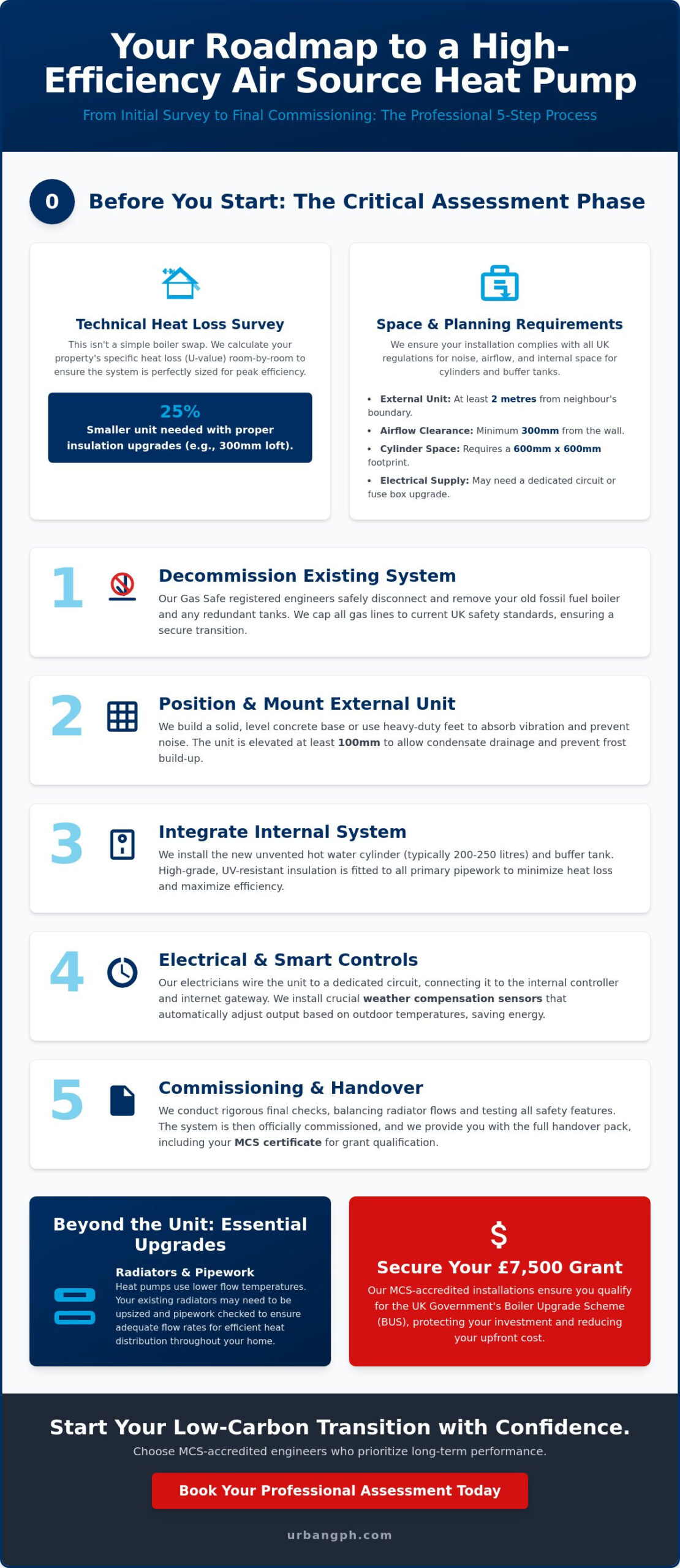
Proper air source heat pump installation starts with a meticulous site assessment. We don’t guess. We measure. A heat pump works differently than a gas boiler; it provides a steady, lower grade of heat over a longer period. If your home leaks heat, the pump works too hard and your efficiency drops. We look at your radiators, your pipework, and your insulation levels to ensure the system is fit for purpose. This professional approach ensures your transition to renewable heating is seamless and stress-free.
The Technical Heat Loss Survey
Our engineers calculate the “u-value” of your walls, windows, and roof insulation. This value measures how fast heat escapes your property. In 2026, UK standards require precise room-by-room data to match the unit size to the specific demand of your home. We check every corner. If your insulation is poor, you’ll need a larger, more expensive unit. Upgrading your loft insulation to 300mm or installing cavity wall insulation can reduce the required heat pump size by up to 25 percent. This survey is the foundation of a trusted, MCS-compliant installation.
Space and Planning Requirements
Most installations fall under Permitted Development Rights in the UK. You won’t usually need planning permission if the unit is under 0.6 cubic metres. However, the “2-metre rule” is strict. The external unit must be at least 2 metres from your neighbour’s boundary to comply with noise regulations. Adequate airflow is vital for a high Coefficient of Performance (CoP). You also need internal space. A standard 200-litre or 250-litre unvented hot water cylinder and a buffer tank will likely replace your old setup. We help you find the right spot in your utility room or airing cupboard. Book a trusted engineer today to evaluate your home’s layout.
- External Clearance: Minimum 300mm from the wall for airflow.
- Noise Compliance: Must meet MCS020 sound standards.
- Cylinder Space: Typically requires a 600mm x 600mm footprint.
- Electrical Supply: May require a fuse box upgrade to handle the heat pump load.
The 5-Step Heat Pump Installation Process Explained
A professional air source heat pump installation requires technical precision and a disciplined approach. Our team starts by securing the work area. We use protective coverings to shield your flooring and furniture. Once the site is safe, we decommission your existing fossil fuel system. This involves the safe removal of your old boiler and any redundant tanks. We ensure all gas lines are capped and certified according to current UK safety regulations. Our Gas Safe registered experts handle this transition with speed and efficiency to minimize your time without hot water.
External Unit Positioning and Mounting
The outdoor unit needs a solid foundation to operate quietly and efficiently. We construct a level concrete base or install specialized heavy-duty feet to absorb vibrations. This prevents noise transfer into your home structure. We elevate the unit at least 100mm to allow for condensate drainage and to prevent frost build-up during winter months. Our engineers then install high-grade, UV-resistant insulation on the primary flow and return pipework. This step is vital to minimize heat loss before the energy even reaches your radiators. It ensures your system maintains its 2026 efficiency ratings even in freezing conditions.
Electrical Integration and Smart Controls
Your home’s electrical system often needs an upgrade to support the new load. We assess your consumer unit and install a dedicated circuit if necessary. Our electricians wire the external unit to the internal controller and the internet gateway. This allows for remote monitoring and vital software updates. We also install weather compensation sensors. These sensors detect outdoor temperature shifts and adjust the heat pump’s output automatically. It ensures your home stays warm without wasting energy. This smart integration is what makes a modern air source heat pump installation so much more efficient than a traditional boiler. If you also want year-round climate control including summer cooling, our guide on air to air heat pumps explains how a single system can handle both heating and cooling for total home comfort.
The final stage is the commissioning process. We don’t just turn the system on. We perform a full central heating system flush to remove debris and sludge from your existing pipes. We then fill the system with a specific glycol-water mix to prevent internal freezing. Our multi-stage commissioning follows strict MCS standards to verify flow rates and pressure. We provide a full handover to show you how to use the new interface. If you need a reliable heating engineer to assess your property’s suitability, our team provides expert guidance across the South Coast. We ensure every component is calibrated for maximum performance before we sign off the project.
Essential Infrastructure Upgrades: Beyond the Heat Pump Unit
A successful air source heat pump installation requires more than just placing a unit outside your home. The entire internal heating distribution system must be capable of handling low-temperature water. Gas boilers typically circulate water at 70°C, but heat pumps are most efficient when operating between 35°C and 45°C. This lower temperature means your home needs larger surface areas to emit the same amount of heat. Without these upgrades, your system will work harder, increasing your energy bills and reducing the lifespan of the equipment.
Radiator Resizing and Emitter Upgrades
The science of low-flow temperatures is simple: to get the same warmth from cooler water, you need more surface area. Many homeowners find their existing radiators are undersized for a heat pump. You may need to upgrade to “Type 22” or “Type 33” radiators, which feature double or triple panels and fins to maximize heat output. If wall space is limited, specialized low-temperature fan-assisted emitters are an excellent alternative. These units use small, silent fans to pull air over the heating coils, providing high heat output from a compact footprint. For a complete system overhaul, check our guide on choosing the best hot water cylinder to ensure your domestic hot water matches your new heating efficiency.
Pipework and Flow Rates
Your existing pipework is the veins of your heating system. It must be wide enough to allow for a high flow rate. Many older UK properties use 15mm or 10mm microbore piping, which often restricts the volume of water a heat pump needs to move. To ensure peak performance, your engineer may recommend the following:
- Upgrading to 22mm or 28mm copper piping: This reduces resistance and allows the heat pump to move the necessary water volume efficiently.
- System Power Flushing: We perform a deep clean to remove magnetite and sludge. Debris can easily block the narrow channels in a heat pump’s heat exchanger.
- Flow Rate Optimization: Ensuring the circulator pump doesn’t face excessive “head pressure,” which can lead to noisy pipes and premature pump failure.
Transitioning to an unvented hot water cylinder is also a standard part of a professional air source heat pump installation. These cylinders are designed with larger internal heat exchanger coils specifically for heat pumps. This ensures your water heats up quickly despite the lower flow temperatures. If you have the budget, integrating underfloor heating loops is the gold standard. Because underfloor heating covers such a large surface area, it allows the heat pump to run at its lowest, most efficient temperature, often resulting in the lowest possible running costs for UK homeowners. Homeowners who also want active summer cooling should explore air to air heat pumps as a complementary climate control solution, particularly for properties prone to overheating during warmer months.
Commissioning, Handover, and Navigating the 2026 Boiler Upgrade Scheme
The final phase of your air source heat pump installation is the most critical for long-term efficiency. We don’t just “plug and play.” Our engineers conduct a rigorous testing sequence to ensure the system operates at peak performance. We verify that the flow rates and Delta-T, the temperature difference between the flow and return pipes, align perfectly with the heat loss calculations performed during the design stage. This precision prevents the compressor from overworking and keeps your energy bills low.
Once the technical checks are complete, we walk you through the handover. Living with a heat pump is different from a gas boiler. We teach you how to use the controls and explain why “set and forget” is often more efficient than constant manual adjustments. You’ll receive a comprehensive digital pack containing your MCS certificate, building regulations notifications, and manufacturer warranties. These documents are essential for your insurance and any future home sale.
The Commissioning Checklist
- SCoP Verification: We confirm the Seasonal Coefficient of Performance (SCoP) meets the design targets set for your specific Portsmouth or Southampton property.
- System Purging: Our team bleeds all air from the system and checks every new connection for micro-leaks using high-precision pressure gauges.
- F-Gas Compliance: For split system installations, we register the specific F-Gas details of the refrigerant circuit to meet UK environmental safety standards.
- Electrical Safety: We perform a full diagnostic on the dedicated consumer unit and wiring to ensure total electrical integrity.
Accessing Government Grants in 2026
The Boiler Upgrade Scheme (BUS) remains a vital resource for UK homeowners in 2026. Currently, the scheme provides a fixed grant of £7,500 toward the cost of your air source heat pump installation. This funding is issued on a first-come, first-served basis, so securing your voucher early is vital for your project budget.
To qualify, your property must have a valid Energy Performance Certificate (EPC) issued within the last 10 years. Crucially, the EPC must show no outstanding recommendations for loft or cavity wall insulation. If your home needs these upgrades, they must be completed before the grant application proceeds. Urban Gas simplifies this entire process by handling the BUS application on your behalf. We manage the paperwork and deduct the £7,500 directly from your final invoice, so you don’t have to wait for a reimbursement.
Ready to upgrade your home heating with a trusted local expert? Book your expert installation assessment today and secure your £7,500 government grant.
Selecting a Qualified Installer for Your Low-Carbon Transition
Choosing the right professional for your air source heat pump installation determines whether your system runs at peak efficiency or becomes a costly burden. In the UK, MCS accreditation is your non-negotiable benchmark. This certification ensures the installer meets rigorous quality standards and, crucially, makes your project eligible for government grants like the Boiler Upgrade Scheme. Without an MCS-certified engineer, you forfeit access to the £7,500 subsidy and lose the guarantee that your system is designed for maximum performance.
Avoid “product-only” salesmen who focus solely on the outdoor unit. A successful transition requires a “system-first” engineer. These experts evaluate your entire home. They check pipework diameters and radiator surface areas to ensure the low-flow temperatures of a heat pump can actually keep you warm. A poorly designed system forces the pump to work harder; this spikes your electricity bills and shortens the equipment’s lifespan. Reliability starts with a design that respects the physics of your property.
Questions to Ask Your Potential Installer
- Can you provide a full room-by-room heat loss calculation report? This is the only way to accurately size your heat pump. Guesswork leads to higher running costs.
- What is the expected SCoP for my specific property and radiator setup? A Seasonal Coefficient of Performance (SCoP) of 3.0 or higher is the standard goal for 2026.
- Is the quote “fixed-price” or are infrastructure upgrades extra? Ensure you won’t face surprise costs for electrical consumer unit upgrades or larger pipework later.
The Urban Gas Reliability Promise
Urban Gas Plumbing and Heating delivers Gas Safe and MCS-registered excellence across the South Coast, including Portsmouth, Southampton, and Chichester. We don’t just install units; we engineer solutions. Our team provides fast, reliable response times for the initial air source heat pump installation and essential heat pump servicing. We treat your home with the urgency of an emergency responder and the precision of a master technician.
Long-term performance relies on consistent maintenance. An annual service keeps your manufacturer warranty valid and ensures the refrigerant levels and fans operate correctly. We offer comprehensive support to keep your system running at 300% efficiency or higher for years to come. Trust a local authority that prioritizes your comfort and carbon reduction above all else. We have the expertise to manage your transition from start to finish.
Secure Your Low-Carbon Future Today
Transitioning to renewable energy requires more than just a new unit. It involves a detailed property assessment and critical infrastructure upgrades to ensure maximum efficiency. Navigating the 2026 Boiler Upgrade Scheme is essential to offset costs; the UK government currently offers a £7,500 grant to help homeowners switch. A successful air source heat pump installation relies on technical precision and a clear understanding of your home’s unique heating demands.
Urbangph delivers the reliability you expect from a local leader. Our MCS Accredited Installers and Gas Safe Registered Engineers provide Fixed-Price Installation Quotes to keep your project on budget. We handle the complexity so you don’t have to. We’re ready to help you move away from fossil fuels with confidence and speed.
Your path to a more efficient home starts with an expert evaluation. Book a Professional Air Source Heat Pump Survey to get started. It’s time to enjoy a warmer home and lower carbon emissions.
Frequently Asked Questions
How long does a typical air source heat pump installation take?
A standard air source heat pump installation typically takes between 2 and 5 days to complete. The exact duration depends on the complexity of your existing pipework and whether we need to upgrade your hot water cylinder. Our expert engineers work efficiently to minimize disruption; we prioritize getting your heating back online fast.
Will I need to replace all my radiators for a heat pump?
You won’t necessarily need to replace every radiator, but approximately 60% of UK homes require some upgrades to larger models. Heat pumps operate at lower flow temperatures than gas boilers, so larger surface areas are essential to heat rooms effectively. We conduct a full heat loss calculation to determine exactly which radiators stay and which need a professional upgrade.
Can an air source heat pump be installed in an older, terraced house?
Yes, you can install a heat pump in an older terraced house if the property has adequate loft and cavity wall insulation. We’ve successfully completed installations in Victorian properties across Portsmouth and Southampton by ensuring the building’s heat loss is managed. Call us now for a professional assessment to confirm your home’s thermal efficiency meets the 2026 standards.
How much noise does the external heat pump unit actually make?
Modern external units produce between 40 and 60 decibels of sound, which is roughly equivalent to a quiet conversation. Most homeowners find the noise level negligible once the unit is positioned correctly away from bedroom windows. We ensure every air source heat pump installation follows strict MCS guidelines to maintain a peaceful environment for you and your neighbors.
Do I need to keep my old boiler as a backup for very cold days?
You don’t need to keep your old boiler because a correctly sized heat pump provides 100% of your heating even at temperatures as low as -15°C. Keeping a backup boiler adds unnecessary maintenance costs and complicates your system’s efficiency. We remove your old unit and install a high-performance cylinder; our Gas Safe Registered team handles the entire transition.
What is the average cost of air source heat pump installation in 2026?
The average cost for an air source heat pump installation in 2026 ranges from £7,000 to £13,000 after applying the £7,500 Boiler Upgrade Scheme grant. This price includes the unit, labor, and necessary system upgrades like a new unvented cylinder. We provide transparent pricing and help you access available government funding to make the transition affordable.
What maintenance does a heat pump require after installation?
Your heat pump requires a professional service once every 12 months to maintain its manufacturer warranty and peak efficiency. During this check, a qualified engineer inspects the evaporator coil and checks refrigerant levels. Book a trusted engineer today to ensure your system remains fast and reliable for years to come.
Is an air source heat pump installation worth it if I don’t have underfloor heating?
An air source heat pump installation is definitely worth it even without underfloor heating, as modern oversized radiators are highly effective. While underfloor heating is the most efficient partner for a heat pump, high-quality radiators provide the same level of comfort. Our team ensures your system is balanced correctly to deliver consistent warmth throughout your home.