For many homeowners, the scene is all too familiar: crouched under the kitchen sink, desperately turning the filling loop to bring their heating back to life – for the fourth time in a week. If you’re tired of watching your pressure gauge plummet every time the radiators get warm, you’re not alone. Dealing with a boiler losing pressure when heating is on is a common frustration that often points to a specific mechanical failure or a hidden system issue.
We understand the anxiety of hearing water dripping behind a wall or the fear of a total system failure during a cold snap. It’s exhausting to constantly top up a system that should be sealed and self-contained. This guide will show you exactly how to identify if the fault lies within your expansion vessel or if there’s a genuine leak hidden under your floorboards. You’ll learn the clear signs of a failing pressure relief valve and understand when it’s safe to handle the fix yourself versus when you must call a Gas Safe registered engineer. At Urban Gas Plumbing and Heating, our goal is to help you stop the daily pressure drops, ensure your system is safe, and avoid a complete winter breakdown.
Key Takeaways
- Understand the “magic number” for system pressure and how thermal expansion impacts your closed-loop heating.
- Discover exactly why your boiler losing pressure when heating is on and how to diagnose a failing expansion vessel.
- Learn the diagnostic isolation method to quickly determine if the fault lies within the boiler or your home’s pipework.
- Identify safe DIY fixes for common issues like loose radiator nuts and unsealed filling loops.
- Know when to book a Gas Safe registered engineer for a fast, reliable repair to restore your home’s heating.
Boiler Pressure Basics: Why the Gauge Drops During Operation
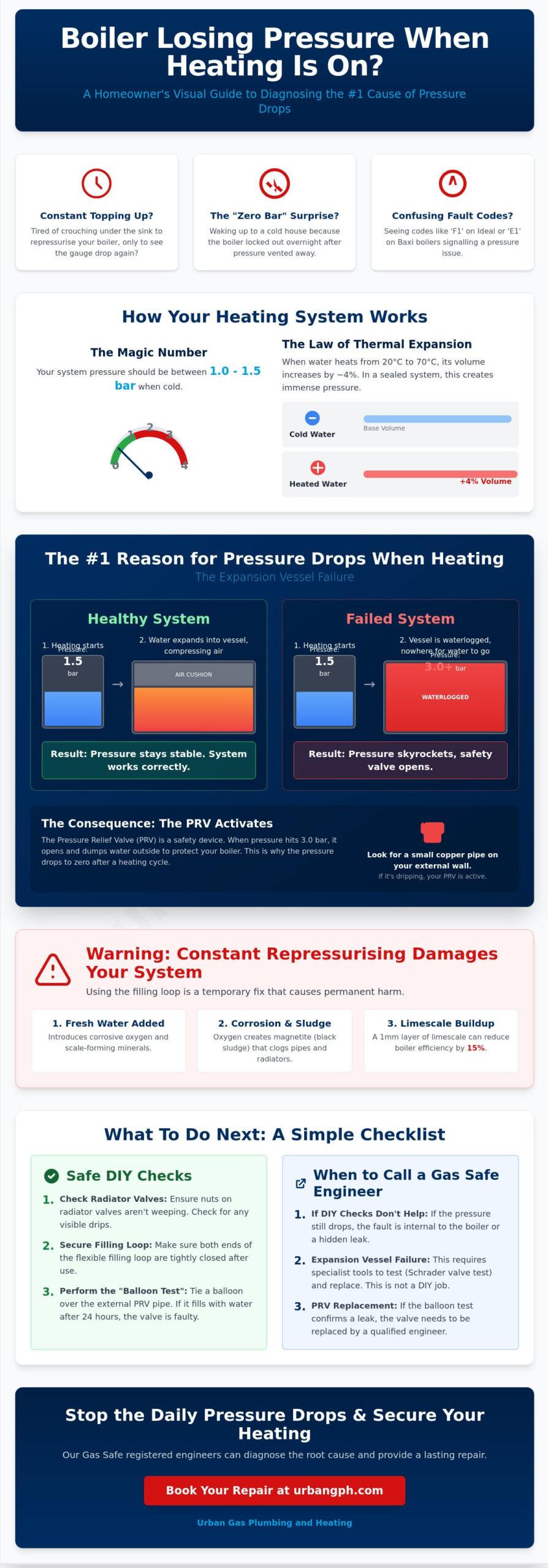
Boiler pressure is the force of water circulating through your pipes and radiators. Most modern UK homes utilize a closed-loop central heating system. This design keeps the same water sealed within the network to maximize efficiency. For 95% of modern combi and system boilers, the magic number on your pressure gauge should sit between 1.0 and 1.5 bar when the system is cold. If you find your boiler losing pressure when heating is on, you are likely dealing with a failure in how the system manages physical changes in water volume.
The physics of your home heating relies on thermal expansion. When water heats from a base temperature of 20°C to an operating temperature of 70°C, its volume increases by approximately 4%. A healthy boiler uses an internal expansion vessel to cushion this extra volume. If this component fails, the pressure rises too high, triggers the safety discharge valve, and leaves you with a depleted system. You must distinguish between a static leak, which causes a slow and constant drop, and an expansion fault that only manifests during a heating cycle.
The Dangers of Constant Repressurising
Topping up your boiler via the filling loop is a temporary fix that causes long-term damage. Every time you add fresh water, you introduce new oxygen and minerals into the system. This oxygen reacts with the internal steel of your radiators, leading to the formation of magnetite, or black sludge. Frequent topping up also accelerates the process of “liming up” your heat exchanger. Industry data suggests that even a 1mm layer of lime scale can reduce boiler efficiency by 15%. This silent killer eventually leads to expensive component failures. Call a Gas Safe Registered engineer to find the root cause rather than relying on the filling loop.
Signs Your Pressure Loss is Heating-Related
Identifying a heating-related fault requires observing the gauge during a live cycle. You might experience the “Zero Bar” morning surprise. This happens when you leave the heating on at night, the pressure spikes and vents out of the overflow pipe, and you wake up to a cold house because the boiler locked out. Look for the “rise and fall” pattern. If the needle climbs toward 3.0 bar while the radiators are hot and then drops to zero as they cool, your expansion vessel has lost its air charge. Your boiler will likely display a fault code to signal this issue. Common codes include F1 on Ideal models or E1 on Baxi systems. Our team provides Same-Day Service to resolve these lockouts and get your heat back online immediately.
The Expansion Vessel: The #1 Reason for Pressure Drops
Your expansion vessel acts as the “lung” of your central heating system. When water heats up, it expands. This vessel contains a rubber diaphragm that separates a cushion of compressed air from the system water. This air cushion absorbs the extra volume. If the diaphragm perishes or the air charge leaks out, the water has nowhere to expand. This causes the internal pressure to skyrocket from a standard 1.5 bar to 3.0 bar or higher within 10 minutes of the heating coming on. This rapid spike is the primary reason for a boiler losing pressure when heating is on because the system eventually vents that excess water to prevent an explosion.
A Gas Safe registered engineer checks this component using the “Schrader Valve” test. This valve looks exactly like the one on a car tyre. If the engineer presses the pin and water squirts out, the internal membrane has failed. The vessel is “waterlogged” and requires immediate replacement. Regular servicing and maintaining your furnace or boiler ensures these air charges stay at the correct level, preventing 85% of common pressure-related breakdowns.
The Pressure Relief Valve (PRV) Connection
The Pressure Relief Valve is a critical safety component designed to “blow off” when pressure exceeds safe limits. If your expansion vessel fails, the PRV opens to dump water and protect your boiler’s internal parts. You can identify this by looking at the small copper discharge pipe on your property’s external wall. If it is dripping or shows signs of water staining, the valve is passing water.
Try the “Balloon Test” for a quick DIY diagnosis. Secure a small balloon over the end of the external copper pipe with an elastic band. Check it after 24 hours. If the balloon contains water, your PRV is leaking. This constant loss of water is why you keep seeing the gauge drop to zero.
Undersized Vessels and System Upgrades
Homeowners in Portsmouth and Southampton often encounter pressure issues after home renovations. Adding three or four new radiators to an existing system can overwhelm a standard 8-litre internal expansion vessel. The vessel simply isn’t large enough to handle the new volume of water. Signs of an undersized system include:
- Pressure rising too quickly even when the vessel is healthy.
- Frequent need to top up the system after adding new towel rails or radiators.
- The boiler locking out with an “F1” or “E1” fault code during peak winter usage.
The solution is straightforward. We install an additional external expansion vessel, usually finished in white or red, to support the system’s increased capacity. This provides the extra “breathing room” your boiler needs to operate safely. If your gauge won’t stay steady, book a professional engineer to calculate your system’s required capacity today.
Diagnostic Isolation: Is the Problem the Boiler or the Pipes?
Isolating the boiler from the rest of the central heating system is the fastest way to stop the guesswork. You don’t need tools for this test, just a few hours of observation. Follow these steps to pinpoint the source of the drop. First, repressurise your system to exactly 1.5 bar using the filling loop. Turn the boiler off completely at the fused spur so it doesn’t fire up during the test. Locate the isolation valves on the flow and return pipes; these are usually the two 22mm copper pipes on the far left and right under the casing. Turn these valves to the closed position to trap the water inside the boiler unit.
Leave the system isolated overnight. Check the pressure gauge the following morning. If the needle has dropped while the valves were closed, the leak is internal to the boiler. If the pressure stayed at 1.5 bar but drops immediately after you open the valves, the leak is located in your radiators or underfloor pipework. This diagnostic step is vital for our Gas Safe Registered engineers to provide a fast, reliable fix when they arrive at your home.
Identifying Internal Boiler Leaks
Internal leaks are often hidden from view. A cracked secondary heat exchanger is a frequent issue; it leaks water directly into the condensate trap where it drains away unnoticed. You should also check the Automatic Air Vent (AAV). These components often weep water after years of service. Understanding these common causes for a boiler losing pressure is essential for maintaining system health. Aging seals and washers also fail due to constant heat cycles, particularly in older Combi models. If you see water dripping from the bottom of the boiler casing, call a professional immediately to prevent electrical damage.
Locating Hidden System Leaks
System leaks often only appear when the metal expands. You might notice your boiler losing pressure when heating is on because the heat forces tiny gaps in radiator valves (TRVs) to open. In multi-storey UK homes, water can travel along floor joists and emerge far from the actual leak site. Inspect every radiator union for green copper oxide staining or damp carpets. High operating pressure during a heating cycle pushes water through weakened joints that may remain watertight when the system is cold. If you can’t find a visible puddle, the leak is likely under floorboards or within a wall cavity.
- Check TRVs: Look for “weeping” around the valve nuts.
- Inspect Joists: Trace damp patches on ceilings back to the pipes above.
- Monitor Pressure: Watch the gauge as the temperature rises to 60°C.
Don’t let a small leak turn into a flooded home. Our team provides same-day service across Portsmouth and Southampton to get your heating back on track. Book a trusted engineer today for a full system health check.
Step-by-Step Fixes: What You Can Safely Check
If your boiler losing pressure when heating is on, you don’t always need to call for backup immediately. Start with a visual inspection of your radiators. Look for damp patches around the valves. You can safely use a spanner to tighten the radiator nuts by a quarter turn if you spot a slow drip. This is the limit of DIY plumbing for most homeowners. Don’t force a connection or attempt to dismantle the valve yourself as this can lead to a significant leak.
Next, check the filling loop. This is the silver braided hose usually located underneath or near your boiler. Ensure both black handles are turned fully to the off position. If these valves are left slightly open, they can “pass” water. This causes the system pressure to fluctuate or rise too high and then drop suddenly. Also, check the copper “blow-off” pipe on your external wall. If this pipe is dripping or shows signs of dampness, your pressure relief valve (PRV) is likely faulty. This requires a professional replacement.
Bleeding Radiators Correctly
Bleeding air from your system is a routine task, but doing it incorrectly makes things worse. You must turn your heating off and let the pump stop completely before starting. Bleeding a radiator while the pump is running can actually draw more air into the system through the vent. This often leads to a “rattling” or “gurgling” sound in the pump, which signals trapped air that can damage the internal components.
- Turn off the boiler and wait 20 minutes for the system to cool.
- Use a radiator key to open the vent until water appears.
- Close the vent immediately once the air stops hissing.
- Check your pressure gauge; it will have dropped during this process.
You must repressurise the boiler to roughly 1.5 bar immediately after bleeding. Leaving the pressure low can prevent the boiler from firing up entirely.
When to Call a Gas Safe Engineer
UK law is strict: homeowners must never open the boiler casing. This is a sealed unit designed to contain dangerous products of combustion. If you smell gas, see scorched marks on the casing, or notice yellow flames instead of a crisp blue, shut the gas off at the meter. These are critical warning signs of a dangerous fault that requires an immediate response.
Prepare for the engineer’s visit by tracking your system’s behavior. Note down if you have to top up the pressure every 24 hours or once a week. This data helps our Gas Safe Registered experts find the leak faster. For a fast, reliable repair, book a trusted engineer today to protect your home and your warranty.
Professional Boiler Repair: Restoring Stability with Urban Gas
A boiler losing pressure when heating is on signifies a system struggling to regulate its internal environment. Urban Gas Plumbing and Heating provides a rapid-response diagnostic service designed to identify whether the fault lies in a failing expansion vessel, a weeping pressure relief valve, or a hidden leak. Our engineers arrive on-site with the tools required to test your system’s integrity immediately. We don’t believe in temporary fixes that lead to repeat callouts; we focus on long-term stability.
Every internal boiler repair must be conducted by a Gas Safe registered engineer. This isn’t just a recommendation; it’s a legal safety requirement in the UK. Our team specializes in technical tasks like expansion vessel recharging, where we restore the internal air cushion to its correct factory setting, typically between 0.75 and 1.0 bar. If your Pressure Relief Valve (PRV) has failed due to constant discharge, we replace it with genuine manufacturer parts to ensure your system can vent safely in the future.
Once we’ve resolved the immediate pressure loss, we often recommend a central heating system power flush. Fixing a leak often requires draining the system, which introduces fresh oxygen and can dislodge settled debris. A professional flush removes magnetite and sludge that could otherwise cause future blockages or damage your new components. This proactive step protects your investment and improves overall heating efficiency.
Expert Servicing and Maintenance Plans
Regular maintenance is the most effective way to prevent your boiler losing pressure when heating is on. Annual servicing allows our engineers to check the pre-charge in your expansion vessel before it causes a total breakdown. Urban Gas Plumbing and Heating offers fully insured, reliable repairs that keep your manufacturer warranty valid. We provide a documented service history that proves your heating system meets current UK safety standards and operates at maximum efficiency.
Book Your Trusted Engineer Today
We make it simple to secure a professional diagnostic visit. Our team operates across the South Coast, providing same-day service to homeowners in Portsmouth, Southampton, and Chichester. You’ll receive transparent pricing and a clear explanation of the required work before we start. Don’t let a minor pressure drop turn into a costly emergency. Contact Urban Gas Plumbing and Heating for expert boiler repairs and servicing to get your heating system back to peak performance today.
Similarly, for residential heating and cooling needs, Crome Mechanical offers comprehensive HVAC services that mirror this commitment to system health and efficiency.
Get Your Central Heating Back on Track
A boiler losing pressure when heating is on is a clear signal that your system needs immediate attention. Most cases involve a faulty expansion vessel or a leak hidden within the pipework. These issues do not fix themselves and often lead to higher energy bills or a total system shutdown. Maintaining a steady 1.5 bar pressure is essential for safe operation and peak performance in any UK home.
Our team of Gas Safe Registered Engineers provides same-day emergency service to resolve these faults quickly. We bring expert diagnostics for all major boiler brands to every job. Whether it is a failing pressure relief valve or an internal component failure, we have the tools to fix it right the first time. We have helped thousands of homeowners across the South Coast restore their heating within 24 hours of a call.
Stop worrying about your boiler gauge and let the professionals handle the hard work. Book a Fast, Reliable Boiler Repair with Urban Gas to secure your home’s warmth. Our experts are ready to get your system running safely and efficiently again today.
Frequently Asked Questions
Is it safe to use my boiler if it keeps losing pressure?
It’s generally safe to use your boiler at low pressure, but the system will not operate efficiently. Most modern units include a safety sensor that shuts the system down if pressure drops below 0.5 bar to prevent internal damage. You should book a Gas Safe Registered engineer quickly because running a struggling system puts unnecessary strain on the pump and central heating components. Our team provides Same-Day Service to ensure your home stays warm and safe.
How often should I have to top up my boiler pressure?
You should only need to top up your boiler pressure once or twice a year. It’s normal for a sealed system to lose a tiny amount of pressure over 12 months of operation. If you’re repressurising the system every few weeks, you have a leak or a failing expansion vessel. Frequent topping up introduces fresh oxygen into the pipes, which leads to internal corrosion and can increase long-term repair costs by 20 percent.
Can a leaking radiator cause the boiler to lose pressure only when the heating is on?
Yes, a radiator leak often shows up more clearly when the system is hot. Heat causes metal components to expand, which can open up tiny gaps in radiator valves or pinhole leaks in the panels. You might notice your boiler losing pressure when heating is on because the water escapes faster under higher temperatures and increased system pressure. Check your floorboards and valve joins for damp patches immediately to prevent structural damage.
What happens if I overfill my boiler past 2.0 bar?
If you overfill your boiler past 2.0 bar, the Pressure Relief Valve (PRV) will usually discharge the excess water through a pipe leading outside. This safety mechanism protects your internal pipework from bursting due to excessive force. You can lower the pressure yourself by bleeding a radiator into a bucket until the needle returns to the 1.0 to 1.5 bar range. Don’t leave the pressure too high, as it stresses the heat exchanger and seals.
Why does my boiler pressure go up when the heating is on but drop when it is off?
This pattern usually indicates that your expansion vessel has failed or lost its air charge. When water heats up, it expands, and the vessel must absorb this extra volume. If the vessel is faulty, the pressure rises rapidly, triggers the safety valve to dump water, and leaves the system empty when it cools down. This is a common reason for a boiler losing pressure when heating is on and requires a professional inspection.
How much does it cost to fix a failed expansion vessel in the UK?
Repairing or replacing a failed expansion vessel in the UK typically costs between £150 and £450 depending on your boiler model. According to 2024 industry price data, a simple recharge of the vessel might only cost £80 to £120 in labour. However, if the internal rubber diaphragm is perished, a full replacement is the only reliable fix. We provide transparent, fixed quotes for homeowners across Portsmouth and Southampton before any work begins.
Can I repressurise my boiler myself or do I need a plumber?
You can repressurise most modern boilers yourself using the built-in or external filling loop. It’s a simple process of opening two valves until the pressure gauge reaches the 1.5 bar mark. If the pressure drops again within 48 hours, you must call a Gas Safe Registered engineer to find the root cause. While topping up is a DIY task, repairing the leaks or internal components that caused the drop requires professional certification.
Will a power flush fix my boiler pressure problems?
A power flush is unlikely to fix a pressure loss problem and is designed for different issues. Power flushing removes sludge and magnetite to improve heat distribution, but it doesn’t seal leaks or fix mechanical parts like the expansion vessel. In some cases, the high pressure of a flush can actually expose existing weak spots in old, corroded radiators. Focus on leak detection and component testing first to solve pressure drops effectively.