
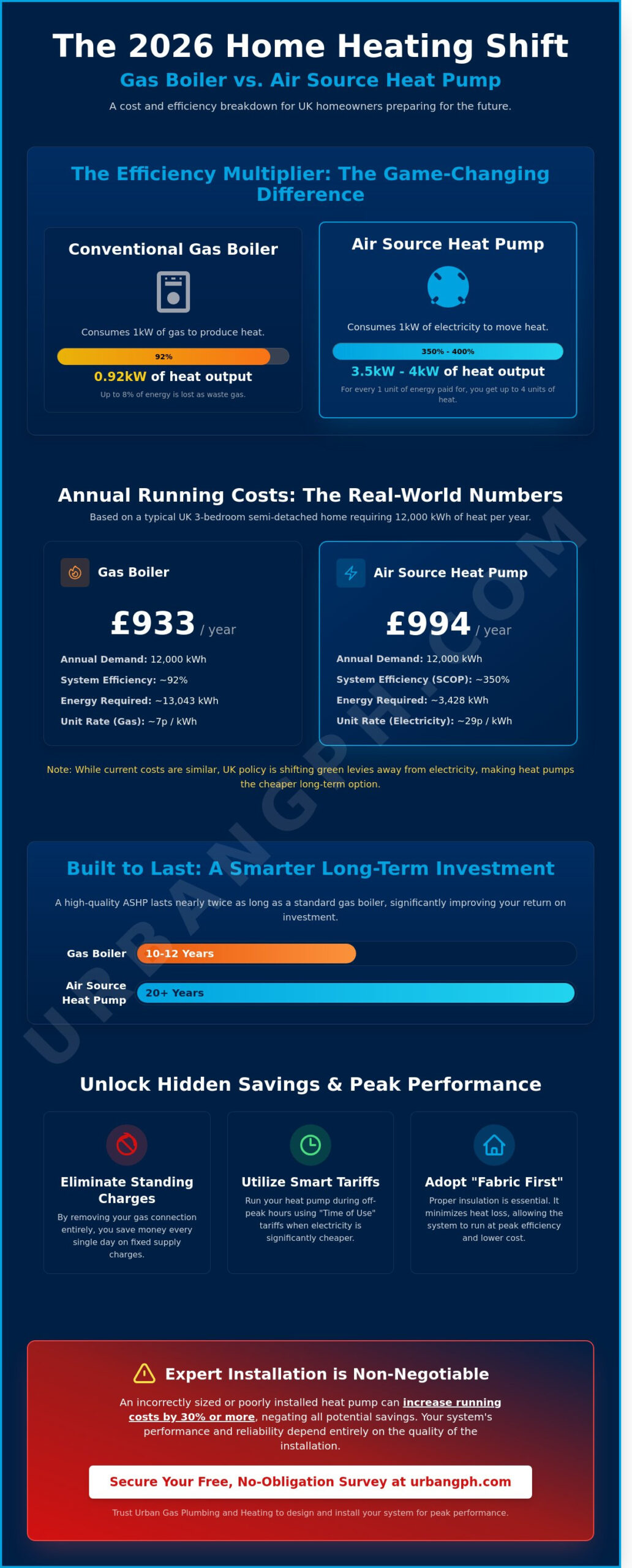
The cheapest way to heat your home in 2026 isn’t the gas boiler you’ve relied on for decades. It is a technology that thrives in the cold. You’ve likely heard that electricity costs more than gas. At the current October 2024 price cap of £1,717, that is true. However, when you compare air source heat pump running costs vs gas, the math changes because of pure efficiency. A standard A-rated gas boiler operates at roughly 92% efficiency. In contrast, a modern heat pump delivers 300% to 400% efficiency. This means for every 1kW of power you pay for, you get up to 4kW of heat delivered to your home.
We understand the stress of high bills and the confusion surrounding COP ratings. It’s difficult to plan when you’re worried about a cold home. This guide provides clarity on 2026 energy pricing and smart tariff advantages. You’ll learn how to lower monthly bills, future-proof your property, and understand the exact ROI of your investment. We are here to show you how to transition to a reliable system that keeps your family warm without the fossil fuel price hikes.
Key Takeaways
- Understand how the 2026 “Efficiency Multiplier” offsets higher electricity prices to deliver superior heating performance compared to traditional boilers.
- Access a detailed breakdown of air source heat pump running costs vs gas for a standard UK 3-bedroom semi-detached home.
- Identify hidden savings by removing your gas connection entirely and utilizing smart “Time of Use” energy tariffs to slash bills.
- Learn why a “fabric first” insulation strategy is essential for maximizing system efficiency and maintaining a low-temperature, high-comfort home.
- Discover how expert engineering from Urban Gas Plumbing and Heating ensures your new system is precision-installed for peak performance and long-term reliability.
Table of Contents
- Unit Price vs. Efficiency: Why Electricity Wins Despite the Cost
- Calculating the Real-World Costs: ASHP vs. Gas Boiler
- The Hidden Savings: Standing Charges and Smart Energy Tariffs
- Maximising Efficiency: Factors That Lower Your Monthly Bills
- Expert Installation: The Key to Low Running Costs with Urban Gas
Unit Price vs. Efficiency: Why Electricity Wins Despite the Cost
Electricity costs more than gas. There is no way around that raw fact. Under the current Ofgem price cap, electricity sits at approximately 24.5p per kWh, while gas is significantly lower at roughly 6.2p per kWh. This price gap often scares homeowners in Portsmouth and across the South Coast. They assume switching to electric heating will quadruple their monthly bills. This is a common misconception. It ignores the fundamental physics of how heat is generated and delivered to your radiators.
The reality is that air source heat pump running costs vs gas are not determined by the fuel price alone. You must look at the “Efficiency Multiplier.” A modern, A-rated gas boiler operates at about 90% efficiency. For every £1.00 you spend on gas, 10p is wasted through the flue. An air source heat pump operates at 300% to 400% efficiency. It doesn’t create heat by burning fuel; it moves heat from the outside air into your home. This massive efficiency advantage levels the playing field.
Understanding Coefficient of Performance (COP)
COP is the ratio of heat output to electricity input. If your system has a COP of 3.0, it produces 3kWh of heat for every 1kWh of electricity it consumes. This is why understanding How Air Source Heat Pumps Work is vital for any homeowner. In the UK, a COP of 3.0 is generally considered the “break-even” point where running costs match a gas boiler.
- COP 3.0: You get 3 units of heat for the price of 1 unit of power.
- SCOP: The Seasonal Coefficient of Performance calculates efficiency over a full year.
- Performance: High-quality installs often achieve an SCOP of 3.5 to 4.0.
Our expert engineers focus on SCOP because it accounts for the cold UK winters. While efficiency drops when the temperature hits zero, the yearly average remains high enough to keep bills manageable. A well-designed system ensures you aren’t overpaying during the coldest months.
The 2026 Energy Price Cap Context
The “spark gap” is the ratio between electricity and gas prices. Historically, electricity was nearly five times more expensive than gas. This gap is narrowing. Government policy is moving green levies away from electricity bills and onto general taxation or fossil fuel charges. By 2026, this shift will make renewable electricity even more attractive for home heating.
Current energy trends show a clear trajectory. Gas prices remain volatile due to global supply chains. Electricity is increasingly generated by cheaper, domestic renewables like wind and solar. We provide fast, reliable advice to help you prepare for these shifts. Transitioning now protects you from future gas price hikes. It positions your home as a modern, efficient property. Trust a professional team to size your system correctly. Correct sizing is the only way to ensure your air source heat pump running costs vs gas remain in your favour.
Calculating the Real-World Costs: ASHP vs. Gas Boiler
Comparing air source heat pump running costs vs gas requires looking beyond the monthly bill. You must calculate the total energy input against the heat output. For a standard 3-bedroom semi-detached home in Portsmouth or Southampton, the annual heating and hot water demand typically averages 12,000 kWh. A modern condensing gas boiler operates at roughly 90% efficiency. An ASHP delivers a Seasonal Coefficient of Performance (SCOP) of around 3.5, meaning it produces 3.5 units of heat for every 1 unit of electricity used.
The math is straightforward: (Annual Heating Demand / Efficiency) x Unit Rate. Based on current UK price caps of roughly 7p per kWh for gas and 29p per kWh for electricity, a gas boiler costs about £933 per year to run. A well-installed heat pump costs approximately £994. While the heat pump appears slightly more expensive today, UK Parliament evidence on energy levies suggests that shifting environmental costs from electricity to gas bills could soon make ASHPs the cheaper option. You should also consider system longevity. A standard boiler often requires replacement after 10 to 12 years. A high-quality ASHP is a 20-year investment, doubling the lifespan of traditional fossil fuel systems.
Annual Running Cost Comparison
- Moderate Energy User (12,000 kWh demand): Gas Boiler (£933) | ASHP (£994)
- High Energy User (18,000 kWh demand): Gas Boiler (£1,400) | ASHP (£1,491)
- Poorly Designed System: Costs can rise by 30% if the ASHP is incorrectly sized or paired with small radiators.
Efficiency is the deciding factor. If your installer achieves a SCOP of 4.0 through expert design, your air source heat pump running costs vs gas actually drop below the cost of a boiler. Our team ensures every installation is optimized for maximum efficiency. Book a trusted engineer today to assess your property’s suitability.
The Impact of Seasonal Changes
Running costs fluctuate as the South Coast weather shifts. In summer, your heat pump works effortlessly to provide hot water, often reaching a COP of 4.0 or higher. Winter presents a different challenge. When temperatures drop below 5°C, the unit must perform defrost cycles to clear ice from the external heat exchanger. These cycles consume extra electricity without contributing to indoor warmth, which temporarily lowers efficiency. Winter SCOP measures the average performance across the cold months, while Summer COP reflects the peak efficiency during warmer periods. Even in a Chichester frost, a professional installation keeps your home warm without the system working overtime.
The Hidden Savings: Standing Charges and Smart Energy Tariffs
Calculating the air source heat pump running costs vs gas requires looking beyond simple unit prices. Many homeowners overlook the structural savings that come from a “Zero-Gas” home. When you switch to a heat pump, you gain the option to remove your gas connection entirely, which fundamentally changes your monthly outgoings.
Eliminating the Gas Standing Charge
Removing your gas meter provides an immediate annual saving. In 2024, gas standing charges typically cost between £100 and £120 per year. This is a fixed fee you pay regardless of how much gas you use. To stop this charge, you must book a Gas Safe registered engineer to safely “cap off” the internal gas pipework. You then notify your supplier to remove the meter and close the account.
Factoring this £120 saving into your annual air source heat pump running costs vs gas comparison is vital. It effectively offsets a portion of your electricity bill before you even turn the heating on. Our expert engineers often help homeowners in Portsmouth and Southampton navigate this process to ensure their transition to a fully electric home is seamless and compliant with safety regulations.
Leveraging Smart Heating Tariffs
The standard price cap is the most expensive way to power a heat pump. Smart “Time of Use” (ToU) tariffs are the key to maximizing your ROI. Innovative providers offer specific products like Octopus Cosy, which provides three windows of cheaper electricity every day. Alternatively, the Agile tariff tracks wholesale prices every 30 minutes, sometimes even paying you to use electricity when supply outstrips demand. This is a total shift from how we used gas boilers in the past.
- Load Shifting: Program your heat pump to run during off-peak windows to heat your home and hot water cylinder.
- Thermal Storage: Your unvented cylinder acts as a battery, storing heat for use during expensive peak times.
- Battery Synergy: Pairing a heat pump with home battery storage allows you to charge up at rates as low as 7p per kWh and use that power when prices peak at 6pm.
Recent data shows that a well-configured heat pump on a smart tariff can be 40% cheaper to run than a traditional gas boiler. This setup moves you away from the volatility of the gas market and puts you in control of your energy spending. It’s a reliable, professional approach to future-proofing your home’s heating system while driving down monthly costs. Don’t settle for standard rates when smart technology can slash your bills.
Maximising Efficiency: Factors That Lower Your Monthly Bills
Efficiency determines your final bill. You cannot simply swap a gas boiler for a heat pump without looking at your home’s “fabric first.” High-quality insulation is the foundation of a low-cost system. According to Energy Saving Trust data from 2023, a detached home can save up to £590 per year on heating bills just by installing cavity wall and loft insulation. Without these measures, your heat pump works harder, consumes more electricity, and increases air source heat pump running costs vs gas.
Weather compensation is another vital tool for cost control. This setting automatically adjusts the heat pump’s output based on the outside temperature. On a mild day, the system runs at a lower capacity to save energy. It prevents the “on-off” cycling that wears down components and spikes electricity usage. Regular annual servicing is just as critical. A dirty evaporator coil or a blocked filter can reduce efficiency by 15% in a single season. Keep your system maintained to stop “efficiency drift” from draining your bank account.
Emitter Sizing and Flow Temperatures
The Role of Professional System Design
A “one-size-fits-all” approach is a recipe for disaster. Every home requires a bespoke, room-by-room heat loss calculation. This process measures exactly how much heat escapes through your walls, windows, and floors. Professional engineers use these figures to size your unit perfectly. Avoid “cowboy” installers who guess the size based on your old boiler. An oversized unit will short-cycle and fail early. An undersized unit will never get your home warm. Precision design is the only way to guarantee the low running costs you expect.
Don’t risk a poor installation that leads to massive energy bills. Book a trusted engineer today for a professional system assessment.
Expert Installation: The Key to Low Running Costs with Urban Gas
Urban Gas operates at the intersection of traditional heating expertise and renewable innovation. We are specialists in both gas boilers and green energy systems. We don’t just install units; we engineer them for peak performance. The real difference in air source heat pump running costs vs gas often comes down to the quality of the initial design. A poorly configured heat pump will struggle, run frequently, and drive up your electricity bills. We prevent this through precision engineering.
The efficiency of your system relies on a high Seasonal Coefficient of Performance (SCOP). Our team ensures your radiators or underfloor heating are perfectly matched to the heat pump’s output. This technical balance is what keeps your monthly outgoings low. We take pride in our status as a reliable local authority in home heating, providing a calm and dependable service for every customer.
Our Gas Safe registered engineers understand the transition from fossil fuels to renewables better than anyone. They know how your old gas system functioned, which allows them to integrate new technology seamlessly. We also offer comprehensive maintenance plans. These plans are designed to protect your long-term savings. A system that isn’t serviced regularly can lose 10% of its efficiency in just a few years, costing you hundreds of pounds in wasted energy.
Why Choose Urban Gas for Your Transition?
We bring decades of experience in traditional and green heating to every project. Our survey process is exhaustive. We don’t guess; we calculate. We perform room-by-room heat loss assessments to guarantee your SCOP targets are met. This data-driven approach ensures your air source heat pump running costs vs gas remain as low as possible from day one.
Our reach is national, but our response is rapid. We maintain a strong presence in Portsmouth, Southampton, and Chichester, acting as the reliable local hero when you need us most. We are fully insured and strictly compliant with all UK safety regulations. You get the peace of mind that comes with professional, high-stakes engineering and a commitment to speed.
Next Steps: From Quote to Commissioning
Booking your heating assessment is fast and straightforward. We handle the technical complexities so you don’t have to. Our team provides clear advice on government incentives, specifically the Boiler Upgrade Scheme (BUS). This scheme currently offers a £7,500 grant to help homeowners in England and Wales transition away from gas. We assist with the application process to ensure you receive the funding you’re entitled to.
Our process moves quickly from the initial survey to final commissioning. We ensure your system is balanced, your controls are easy to use, and your home is warm. We prioritize transparency and reliability in everything we do. Don’t leave your home comfort to chance. Book your expert heating survey today.
Future-Proof Your Home With Smarter Heating
Switching to a heat pump is a strategic move for your bank balance. While electricity unit prices are currently higher than gas, a system operating at 300% to 400% efficiency drastically reduces the total energy you actually buy compared to a 92% efficient gas boiler. By 2026, the gap in air source heat pump running costs vs gas will favor homeowners who adopt smart tariffs and precision-engineered systems. You don’t have to navigate these technical changes alone. Urban Gas provides national coverage with rapid response times to help you upgrade with confidence. Our Gas Safe Registered Engineers specialize in expert ASHP system design, ensuring your installation delivers the maximum possible savings from day one. Take the first step toward a more reliable, cost-effective home heating solution today.
Get a Professional Heat Pump Installation Quote from Urban Gas
The path to lower bills starts with a system built for performance. You’re making a choice that protects your home and your budget for years to come.
Frequently Asked Questions
Is a heat pump really cheaper than a gas boiler in 2026?
Yes, a heat pump can be cheaper to run than a gas boiler in 2026 if your system achieves a Coefficient of Performance (COP) of 3.0 or higher. The UK government’s plan to rebalance green levies from electricity to gas bills makes electric heating more competitive. You’ll see the best results by pairing your unit with a smart tariff. Our expert engineers ensure your system is sized correctly for maximum efficiency.
Do I need to replace all my radiators to keep running costs low?
You don’t always need to replace every radiator in your home. A technical heat loss calculation determines if your existing radiators have enough surface area to heat your home at lower flow temperatures. In many UK retrofits, only 30% of radiators require upgrading to larger Type 22 or Type 33 models. Keeping your flow temperature low is the key to reducing air source heat pump running costs vs gas.
How much can I save by removing my gas standing charge?
You can save approximately £113 per year by disconnecting your gas meter and removing the standing charge entirely. Based on Ofgem’s price cap figures from 2024, the average daily gas standing charge is around 31p. This is a guaranteed saving that offsets a portion of your electricity bill. Switching to a fully electric home eliminates this fixed cost forever and simplifies your monthly energy outgoings.
Will a heat pump work in a cold UK winter without costing a fortune?
Modern air source heat pumps operate efficiently even when outdoor temperatures drop to -15°C. Units using R290 refrigerant maintain high flow temperatures without relying on expensive backup immersion heaters. To keep costs low during a Portsmouth or Southampton winter, ensure your home has adequate loft and cavity wall insulation. A well-insulated home allows the heat pump to run at a steady, low-cost pace even during a cold snap.
What is the best energy tariff for an air source heat pump?
The best energy tariff is a dedicated “time-of-use” plan like Octopus Cosy or OVO’s Heat Pump Overlay. These tariffs offer discounted rates during specific windows, often 50% cheaper than the standard variable rate. Using these windows to pre-heat your home or charge your hot water cylinder significantly reduces your monthly outgoings. Our team can help you understand how to sync your heating schedule with these specific rates.
How often does a heat pump need servicing to stay efficient?
You must service your heat pump once every year to maintain its manufacturer warranty and peak efficiency. A professional service ensures the evaporator coil is clean and the refrigerant levels are correct. Neglecting this annual check can cause the system to work harder, increasing your air source heat pump running costs vs gas. Book a trusted engineer annually to keep your system running reliably and safely.
Can I use a heat pump with my existing hot water cylinder?
You usually cannot use a standard gas boiler cylinder because the internal heat exchanger coil is too small. Heat pumps require a specialist high-recovery unvented cylinder with a much larger surface area coil to transfer heat efficiently at lower temperatures. We install these as part of a full system upgrade. This setup ensures you have plenty of hot water without skyrocketing your electricity usage or causing system errors.
How long does it take for a heat pump to pay for itself compared to gas?
Payback periods typically range between 8 and 12 years when you factor in the £7,500 Boiler Upgrade Scheme grant. This timeline depends on your previous fuel type and the efficiency of your new installation. If you’re replacing an old G-rated boiler or expensive oil heating, the savings are much faster. Investing in a professional installation ensures you hit the efficiency targets needed for a quicker return on your investment.