Your boiler doesn’t just stop working without warning; it usually spends months sending you signals that it’s reaching the end of its 10 to 15 year lifespan. Ignoring these clues could lead to a total breakdown when you need heat most, potentially landing you with an unexpected £4,000 replacement bill. You want a home that stays warm and energy bills that don’t skyrocket while your radiators stay lukewarm.
We understand the anxiety of managing an aging gas appliance, especially with the 2026 regulations now affecting how we heat our homes. This checklist identifies the critical signs my boiler is about to break so you can take action before an emergency occurs. You’ll learn how to diagnose your system’s health, understand when a repair is no longer cost-effective, and see how our flexible monthly payment options help you spread the cost of a modern, high-efficiency upgrade. We’ll give you the clarity you need to keep your home safe and warm all year round.
Key Takeaways
- Identify when your boiler’s age makes it a liability and why parts for units over 12 years old often become impossible to source.
- Recognize the sensory red flags and specific signs my boiler is about to break, including what that “kettling” sound actually means for your system.
- Apply the 50% Rule to decide if a repair is a smart investment or if it’s time to upgrade to a high-efficiency condensing boiler.
- Learn how a professional service from a Gas Safe registered engineer prevents emergency call-outs and keeps your home safe.
- Get a clear roadmap for booking a fast, reliable inspection with Urban Gas Plumbing and Heating and exploring flexible monthly payment options.
The Essential Checklist: 7 Signs Your Boiler is Failing
Your boiler is the heart of your home’s central heating system. When it starts to fail, it rarely happens in total silence. You must stay alert to the signs my boiler is about to break before you’re left without hot water during a South Coast winter. We see homeowners in Portsmouth and Southampton daily who ignored small clues until they became expensive emergencies. Don’t be one of them.
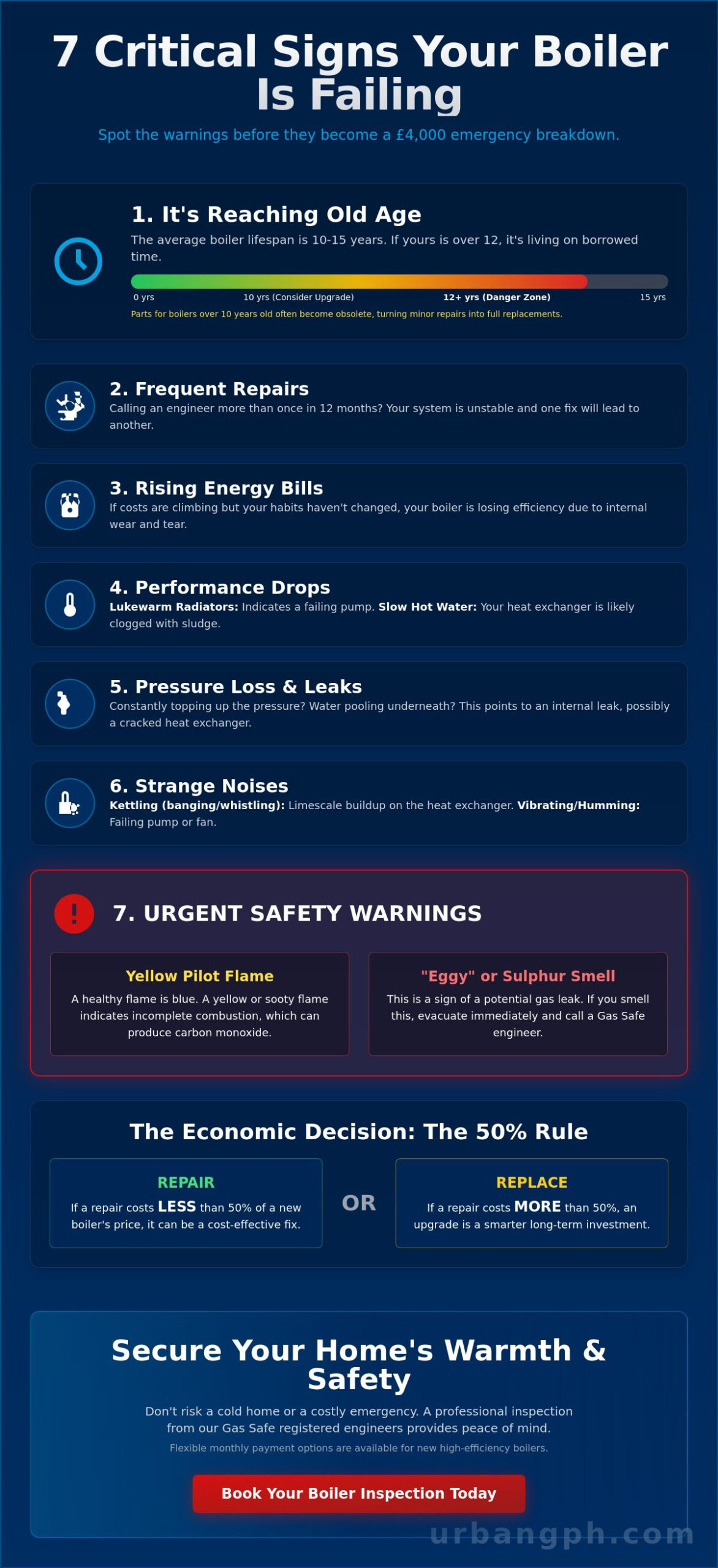
Age is the most predictable factor. If your unit was installed more than 12 years ago, it’s entering the danger zone. While the average lifespan is 10 to 15 years, parts for older models often become obsolete after a decade. This means a minor component failure could force a full replacement simply because the part is no longer manufactured. If your boiler is over 12 years old, you’re on borrowed time.
Frequency of repairs is another clear indicator. A reliable boiler should run between its annual services with zero drama. If you’ve called out an engineer more than once in the last 12 months, your system is fundamentally unstable. Frequent breakdowns suggest that as soon as one part is fixed, the next weakest link will snap. This cycle is a drain on your finances and your peace of mind.
Watch your energy bills and your boiler’s physical appearance. If your gas costs are rising but your usage habits haven’t changed, your boiler’s efficiency is plummeting. Internal corrosion or limescale build-up forces the unit to work harder to reach the same temperature. Also, look for a yellow flame instead of a crisp blue one. A yellow flame is a serious safety warning that requires an immediate inspection from a Gas Safe registered engineer.
Performance Fluctuations and Hot Water Delays
If you’re waiting longer than usual for your taps to run hot, your heat exchanger is likely struggling. This component is responsible for transferring heat to your water, and when it’s coated in sludge, it slows down significantly. Try the lukewarm radiator test: if some rooms stay cold while others are boiling, your pump or diverter valve is failing. A professional power flushing service can sometimes clear this debris, but for a dying unit, it’s often too late to save the internal components.
Inconsistent Pressure Readings
Check your pressure gauge regularly. It should sit steadily between 1 and 1.5 bar. If you find yourself constantly topping it up using the filling loop, you have a problem. While a small leak in a radiator valve is a simple fix, a sudden drop in pressure often points to a failing internal expansion vessel. The worst-case scenario is a cracked heat exchanger. If you see water pooling under the boiler casing, call us immediately. This is one of the most definitive signs my boiler is about to break beyond repair.
Sensory Red Flags: Noises, Smells, and Visual Warnings
Your boiler shouldn’t be a source of mystery. If you start noticing strange sounds or smells, these are often the most reliable signs my boiler is about to break. A healthy system operates with a consistent, quiet hum. Anything else is a cry for help from internal components under extreme stress. We’ve seen homeowners in Chichester and Southampton ignore a small “clunk” only to face a flooded kitchen a week later. Trust your senses; they’re usually right.
Kettling is one of the most common warnings. It sounds like a whistling kettle or a loud banging noise coming from the unit. This happens when limescale or “sludge” builds up on the heat exchanger, restricting water flow and causing local boiling. If you hear vibrating or humming, you’re likely looking at a failing pump or loose internal brackets. These mechanical issues won’t fix themselves. They’ll only get louder until the component snaps entirely.
Smells are even more urgent. A metallic, burning scent suggests that electrical components are overheating or that dust and debris are scorching inside the casing. An “eggy” or sulphurous smell is a sign of a gas leak. If you detect this, don’t wait. Open your windows, get everyone out of the house, and call a Gas Safe registered engineer immediately. Carbon monoxide poisoning presents an unreasonable risk of injury and death, making visual inspections of your boiler casing vital.
Look for soot marks or dark scorching around the edges of the boiler. These visual cues indicate that the flue isn’t venting correctly or that the fuel isn’t burning completely. Heavy corrosion on external pipes or green “fur” on copper joints also points to slow, persistent leaks that will eventually lead to a total system failure. If you spot these red flags, it’s time to book a professional boiler repair before the damage spreads.
The “Yellow Flame” Danger Sign
A healthy boiler flame is always a crisp, transparent blue. If you see a lazy yellow or orange flame, your appliance is not burning fuel correctly and could be producing deadly carbon monoxide. This is a critical safety failure that requires you to turn off your gas supply at the meter and seek urgent professional help.
Deciphering Boiler Noises
- Tapping or knocking: This often signals debris moving through the pipes or pipes expanding against floorboards.
- Whistling: The classic sign of kettling caused by internal blockages in the heat exchanger.
- Gurgling: This usually means there’s trapped air in the system, but if it persists after you’ve bled your radiators, your pump is likely failing.
The Economic Argument: Repair vs. Replacement ROI
Deciding whether to patch up an old unit or invest in a new one is a cold, hard financial calculation. It’s not just about the immediate fix. You need to consider the long-term return on investment. If you’ve already spotted the signs my boiler is about to break, you’re likely facing a quote for parts and labor that could be better spent elsewhere. We recommend using the 50% Rule. If a single repair costs more than half the price of a new installation, it’s a bad investment. You’re essentially paying to delay the inevitable.
Efficiency ratings play a massive role in this decision. Modern A-rated condensing boilers operate at over 90% efficiency. In contrast, older G-rated units can drop as low as 60%. This means for every £1 you spend on gas, 40p is literally disappearing up the flue. By upgrading, you stop that waste immediately. Most homeowners find that a modern system pays for itself through energy bill savings within 3 to 5 years. This makes a new boiler one of the few home improvements that actually generates a cash return.
There is also the “invisible cost” of stress and reliability. An old boiler is a ticking clock. It will likely fail on the coldest day of the year when engineers are at their busiest. A new installation comes with a comprehensive manufacturer warranty, often lasting up to 10 years. This guarantees you zero repair costs for a decade. That peace of mind has a tangible value that a simple repair can never match.
Calculating the True Cost of Keeping an Old Boiler
Emergency call-out fees in Portsmouth or Southampton carry a premium, especially during peak winter months. These unplanned costs quickly add up. Additionally, the efficiency of your hot water cylinder impacts how hard your boiler has to work. If you’re pairing an old, struggling boiler with an inefficient tank, your gas bills will stay high regardless of how many small repairs you authorize. A planned installation allows you to optimize the whole system for the lowest possible running costs.
Accessible Financing and Monthly Installments
A new boiler doesn’t require a massive upfront cash payment that drains your savings. Retail finance options allow you to spread the cost through simple credit applications. You can choose a payment plan that fits your budget with fixed monthly installments. Because a new boiler is so much more efficient, the reduction in your monthly energy bills often covers a significant portion of the finance payment. This makes the transition to a reliable, modern system both affordable and logical.
Preventing the Break: Maintenance and Gas Safety
Prevention isn’t just a suggestion; it’s a financial shield for your home. While we’ve discussed the physical signs my boiler is about to break, the goal is to never see those symptoms in the first place. A standard professional boiler service in the UK typically costs between £80 and £120. When you compare this to the £2,500 to £4,000 cost of a new installation, the logic is clear. Regular maintenance identifies minor component fatigue before it triggers a system-wide failure.
A professional service from a Gas Safe registered engineer is a rigorous technical inspection. It includes a full flue gas analysis to ensure your boiler is burning fuel safely and efficiently. We perform internal cleaning of the burner and heat exchanger to remove the debris that causes “kettling” noises. We also check all safety devices and seals to prevent carbon monoxide leaks. To further protect your system, we recommend a central heating power flush to clear out sludge. Installing a magnetic filter is another vital step; it acts as a permanent guard, catching metallic particles before they can choke your heat exchanger or damage the pump.
Don’t wait for the heating to fail during a cold snap. Taking proactive steps now ensures your system remains reliable and safe. Book your annual boiler service with our expert team today to secure your home’s comfort.
Landlord Gas Safety Obligations
If you rent out a property in Portsmouth or Southampton, annual maintenance is a legal mandate, not a choice. You must hold a valid Landlord Gas Safety Certificate (CP12), which requires a yearly inspection by a Gas Safe registered engineer. Failure to comply can result in unlimited fines or even imprisonment. Beyond the law, proactive servicing is simply better for your bottom line. Most modern boiler warranties are only valid if you can prove the unit has been serviced annually. Skipping a year could void your protection and leave you responsible for the full cost of a breakdown.
When to Call a Professional Immediately
Safety is the absolute priority. You must never attempt to open a boiler casing or repair internal gas components yourself. This is illegal and incredibly dangerous. If you smell gas or see scorching on the casing, turn off the gas at the meter and open all windows. These are definitive signs my boiler is about to break and pose an immediate risk to your family. We provide a fast, reliable same-day service for emergencies because we know that a total breakdown in winter is a crisis that can’t wait. Our engineers arrive with the right tools and certifications to handle the situation decisively.
Recognizing the signs my boiler is about to break is the first step toward securing your home’s comfort. Once you’ve identified the symptoms, you need a decisive partner to handle the solution. We provide a fast, reliable inspection process to diagnose your boiler health with absolute precision. Our engineers don’t guess; they use advanced diagnostic tools to determine if a repair is viable or if a replacement is the only safe path forward.
If your system requires an upgrade, we provide a transparent, fixed-price quote. This means the price we say is the price you pay. There are no hidden surcharges or unexpected labor fees. We also help you navigate the shift toward low-carbon heating. With the Boiler Upgrade Scheme (BUS) currently providing a £7,500 grant for air source heat pump installations, 2026 is a pivotal year for home energy. We’ll assess your property to see if a renewable transition is right for you or if a modern, A-rated gas boiler remains the more practical choice for your specific needs.
Every job we undertake is backed by our professional credentials. We are Gas Safe Registered and fully insured, providing the peace of mind you deserve. Whether you are in Portsmouth, Southampton, or Chichester, our reputation as a “reliable local hero” is built on technical excellence and punctuality. We take pride in our work and your safety. We have the expertise to get your home back to its best without the stress of a prolonged breakdown.
Booking Your Trusted Engineer
Urgent heating failures require an immediate response. We prioritize emergency call-outs with our “Same-Day Service” promise to ensure you aren’t left in the cold. Our approach is direct and professional, focusing on getting your hot water and heating back online as quickly as possible. Don’t wait for a total system collapse. Book a trusted engineer today to assess your system and provide a definitive diagnosis.
Flexible Payment Options
We believe every homeowner should have access to a safe, efficient heating system. This is why we offer flexible retail finance options for new boiler installations. You can spread the cost of your investment over several years with manageable monthly installments. Our team provides total clarity on payment options and credit applications during your consultation. We encourage you to use our online finance calculator to see exactly how affordable a reliable new boiler can be. By offsetting these payments against your lower energy bills, a new system often pays for itself sooner than you think.
Secure Your Home’s Warmth and Safety
Your home deserves a heating system that works without drama. Recognizing the signs my boiler is about to break is the first step toward avoiding a total breakdown. From spotting yellow flames to managing rising energy costs, you now have the clarity to make an informed decision for your family’s comfort. Taking action early prevents a minor fault from becoming a £4,000 emergency replacement during the height of winter.
We offer the reassurance of Gas Safe Registered engineers and the speed of a same-day emergency service. If the 50% Rule suggests a replacement is your best financial path, our flexible retail finance options help you manage the cost through manageable installments. We are fully insured and dedicated to serving our local community with professional, transparent support. You don’t have to face a heating crisis alone.
Take control of your home energy today. Get a fast, reliable boiler quote from our Gas Safe engineers and enjoy the security of a modern, efficient system. We’ll ensure your home stays warm and protected for years to come.
Frequently Asked Questions
How many years does a typical gas boiler last?
A typical gas boiler in the UK lasts between 10 and 15 years. Once a unit passes the 12-year mark, internal components often suffer from significant wear and parts can become obsolete. We recommend planning for a replacement before your system reaches this age to avoid an emergency breakdown during winter.
Is it worth repairing a 10-year-old boiler?
It depends on the specific fault and the total cost of the parts. We use the 50% rule; if a repair quote exceeds half the price of a new installation, replacement is the more logical investment. Older units are often 30% less efficient than modern A-rated models, meaning a repair doesn’t stop the high energy waste.
What are the first signs of a boiler heat exchanger failing?
The first indicators include whistling “kettling” noises and a noticeable delay in getting hot water to your taps. These are critical signs my boiler is about to break because they suggest limescale or sludge has restricted the water flow. You might also notice the system pressure dropping frequently as water escapes through internal cracks.
Can a noisy boiler be dangerous?
Yes, certain noises signal serious safety risks. While a gurgling sound might just be trapped air, loud banging or vibrating often points to an overheating pump or heat exchanger. If these mechanical sounds occur alongside a lazy yellow flame, your boiler could be producing carbon monoxide, requiring an immediate Gas Safe inspection.
How much does a new boiler installation cost in 2026?
As of May 2026, a new boiler installation in the UK typically costs between £2,000 and £4,500. For a standard like-for-like combi boiler replacement, you should expect to pay between £2,500 and £4,000. These figures include the unit and professional labor from a Gas Safe registered engineer.
What should I do if I smell gas near my boiler?
Turn off your gas supply at the meter immediately and open all windows to ventilate the property. Do not use any electrical switches, naked flames, or telephones inside the house. Evacuate all residents and call a Gas Safe registered engineer from a safe distance to locate and repair the leak.
Does a yellow flame always mean carbon monoxide?
A yellow or orange flame is a definitive sign of incomplete combustion, which is the primary cause of carbon monoxide production. A healthy, safe boiler must always display a crisp blue flame. If you see anything else, turn the appliance off and book a professional safety check immediately.
Can I pay for a new boiler in monthly installments?
Yes, we provide flexible retail finance options that allow you to spread the cost over several years. Our team offers transparent credit applications with fixed monthly installments to fit your budget. Because new boilers are over 90% efficient, the savings on your energy bills can often help cover the monthly payment.