You step into the shower at 6:30 AM on a Tuesday in Portsmouth, only to find a weak, lukewarm trickle because the washing machine is running downstairs. It’s a common frustration for homeowners, but it’s one that a modern hot water cylinder can solve instantly. You deserve high-pressure water that doesn’t quit when your family needs it most, especially as UK building regulations shift toward more sustainable heating solutions.
We agree that low shower pressure and running out of hot water are stresses you shouldn’t have to manage. This guide provides the technical clarity you need to choose a system that delivers high-pressure water to every bathroom while slashing your monthly energy costs. By 2026, the UK government targets 600,000 heat pump installations annually, so choosing a future-proofed setup is now a necessity rather than an option.
We’ll break down the essential differences between unvented and vented systems, help you calculate the correct capacity for your household, and explain the latest G3 safety regulations. Our Gas Safe Registered engineers know that technical excellence is the only way to ensure long-term reliability. Let’s get your home ready for the future with a system that works as hard as you do.
Key Takeaways
- Compare vented and unvented systems to determine which setup provides the best water pressure and reliability for your home’s layout.
- Distinguish between direct and indirect heating mechanisms to ensure your system works efficiently with your boiler or immersion heaters.
- Calculate the perfect size for your hot water cylinder to meet household demand and maximize energy efficiency without wasting heat.
- Future-proof your heating by exploring cylinders designed for seamless integration with renewable technology like solar thermal and heat pumps.
- Understand the essential G3 safety regulations and why professional installation by a qualified engineer is critical for unvented systems.
Understanding Hot Water Cylinders: Vented vs. Unvented Systems
Your central heating system depends on a high-performing hot water storage tank to manage the flow of heat throughout your home. This component, typically called a hot water cylinder, acts as a dedicated reservoir. It keeps water hot and ready for your taps, baths, and showers. For homeowners in Portsmouth and Southampton, choosing the right cylinder is the difference between a weak trickle and a powerful shower. You must decide between a traditional vented system or a modern unvented unit.
The choice impacts your home’s infrastructure. Vented systems rely on gravity and loft space. Unvented systems use mains pressure for better performance. Our Gas Safe Registered engineers frequently see 1970s properties upgrading to modern cylinders to meet the demands of growing families. We provide same-day service to ensure your transition to a new system is fast and reliable.
The Vented Cylinder: Reliability for Traditional Homes
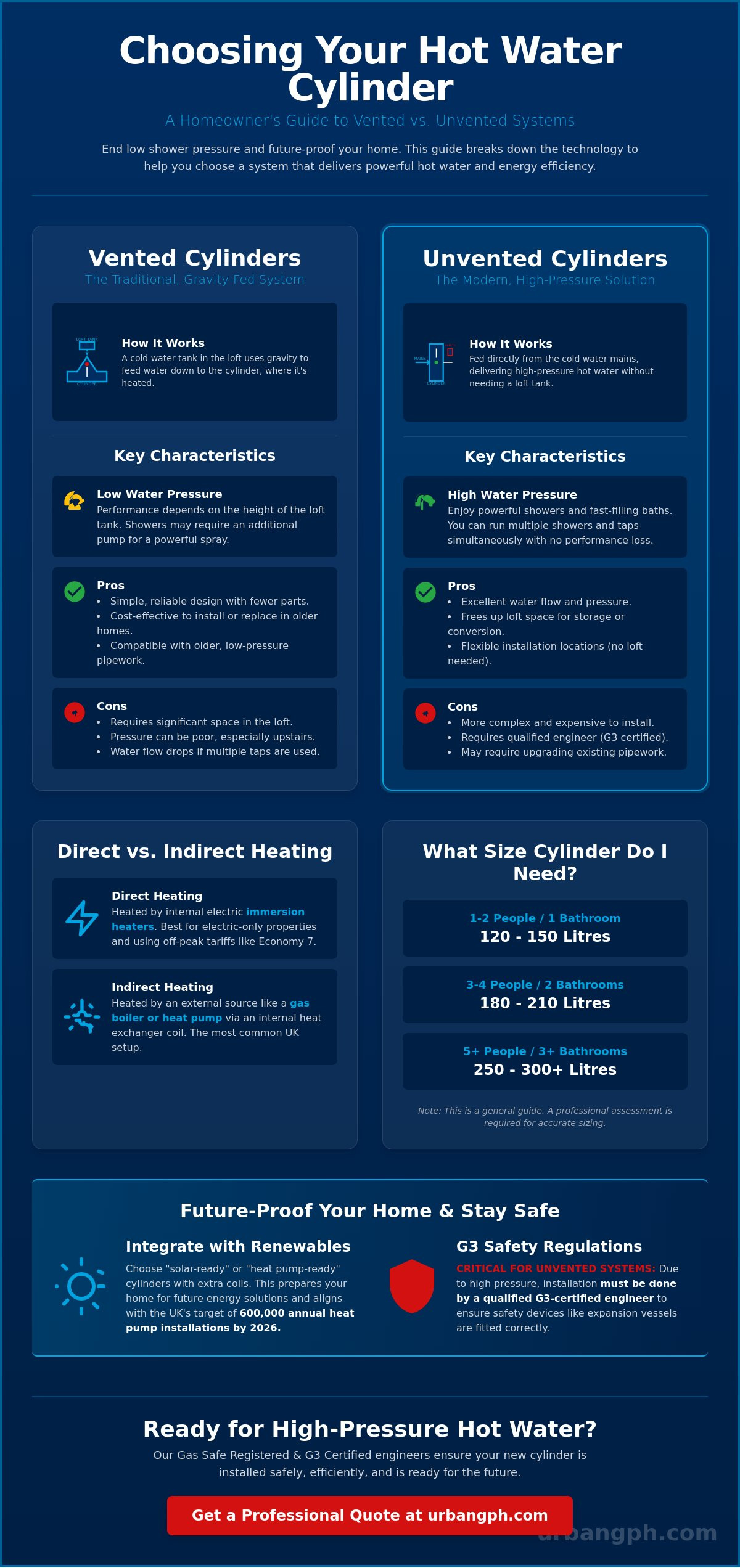
Vented cylinders are a staple in older UK properties. These systems are gravity-fed. They require a large header tank in the loft to provide the necessary pressure. Water travels from the loft tank down to the cylinder, where it is heated by a boiler or an immersion heater. Because they are open to the atmosphere via a vent pipe, they are called vented systems.
- Simple Design: Fewer moving parts make these units easy to maintain.
- Low Pressure: Performance depends on the height of the loft tank. You might need a pump for a powerful shower.
- Cost-Effective: They are often cheaper to install if your home already has the required pipework.
Many homes in Chichester still use this setup. It’s a dependable choice if your existing pipes are older and cannot handle high-pressure mains water. We ensure every vented installation is fully insured and meets current safety standards.
The Unvented Cylinder: High-Performance Hot Water
An unvented hot water cylinder connects directly to your cold water mains. You don’t need a tank in the loft. This saves significant space and allows you to convert your attic into a living area. Because the water is at mains pressure, you get excellent flow rates in every room. You can run two showers at once without a drop in performance.
Safety is the priority with unvented systems. They operate under high pressure. This requires specialized components like expansion vessels and temperature relief valves. Under G3 Building Regulations, only a qualified professional can install or service these units. Our team is fully trained to handle these high-performance systems safely. We offer expert advice to help you pick the right capacity for your household needs. If you face an emergency with your current unit, call us now for a fast response.
Direct vs. Indirect Heating: Which Mechanism Do You Need?
Choosing the correct heating mechanism for your hot water cylinder is a critical decision for your home’s efficiency. You must decide between a direct or an indirect system. This choice depends on your fuel source and your daily demand for hot water. A direct cylinder uses internal immersion heaters to warm the water. An indirect cylinder relies on an external heat source, such as a gas boiler or an air source heat pump. The energy transfers through a high-efficiency heat exchanger coil located inside the tank.
Reliability and safety are the foundations of a professional installation. Our engineers ensure every system complies with the Building Regulations Approved Document G. This government standard dictates how hot water systems must be installed to prevent scalding and ensure proper pressure relief. Following these rules is essential for the safety of your family and the longevity of your plumbing infrastructure.
When to Choose a Direct Cylinder
Direct cylinders are the primary choice for homes without a gas connection. If you live in an electric-only property in Portsmouth or Southampton, this system provides a dependable solution. These units utilize one or two electric immersion heaters. To keep running costs low, homeowners often utilize Economy 7 or Economy 10 tariffs. These plans provide cheaper electricity during off-peak hours, typically between midnight and 7:00 AM. A direct hot water cylinder is also easier to maintain. It has fewer external components and no connection to a complex boiler circuit. This simplicity makes it a favorite for modern apartment living where space and gas access are limited.
The Efficiency of Indirect Cylinders
Indirect cylinders offer superior recovery times for busy households. They integrate directly with your central heating system. Hot water from the boiler circulates through a coil, heating the water in the tank rapidly. An indirect system can often reheat a full tank in under 25 minutes. This is a significant improvement over the 60 to 90 minutes often required by electric immersion heaters. These systems are highly compatible with regular and system boilers. Most modern indirect tanks also feature a dual-fuel option. This includes a backup immersion heater. If your boiler develops a fault, you can switch to electric heating to maintain your supply. It’s an essential redundancy that keeps your home running during an emergency. For a fast, reliable upgrade to your system, book a professional engineer today to ensure your home stays warm and efficient.
Sizing Your Hot Water Cylinder: A Buying Guide for 2026
Selecting the right hot water cylinder requires precision. Many homeowners assume a larger tank is always better. This is a mistake. Over-sizing your system leads to 15% more energy waste through standing heat loss. You end up paying to heat water that you never use. Under-sizing is equally problematic. It results in cold showers and a lack of pressure when multiple taps run at once. Our Gas Safe Registered engineers focus on matching capacity to your peak demand periods.
Start by auditing your daily habits. Do you have a power shower? These can use 15 litres of water per minute. A standard bath requires roughly 80 litres of hot water. To get an accurate estimate for your property, use the Hot Water Association’s sizing calculator. This tool helps you account for every tap and appliance in your home. We recommend choosing a cylinder that meets your needs without excessive surplus. Efficiency is the priority for 2026 energy standards.
Capacity Guide by Household Size
- 1-2 People (1 Bedroom/1 Bath): 120-150 Litres. This range is ideal for smaller flats or couples with low to moderate water usage.
- 3-4 People (3 Bedrooms/2 Baths): 210-250 Litres. This capacity handles simultaneous showers and kitchen use without a drop in temperature.
- 5+ People (Large multi-bathroom homes): 300+ Litres. High-occupancy homes require these larger volumes to ensure everyone has access to hot water during the morning rush.
Physical Dimensions and Installation Space
Measure your airing cupboard before ordering. Standard unvented units usually feature a diameter of 550mm to 600mm. If your storage space is narrow, slimline models reduce the diameter to 475mm. These units are taller to maintain the same volume. For homes with restricted height, such as loft conversions, horizontal models are available. These sit in the eaves and provide the same performance as vertical versions.
Installation requires more than just the hot water cylinder itself. You must leave room for the expansion vessel, discharge pipework, and the Tundish. We maintain a minimum of 200mm clearance around the unit. This ensures our engineers can access the controls for annual servicing or emergency repairs. Accessibility is not optional; it is a safety requirement. Our team in Portsmouth and Southampton provides expert site surveys to confirm your space is compliant. Call us today to book your technical assessment. We guarantee a fast, reliable installation that fits your home perfectly.
Future-Proofing: Solar and Heat Pump Ready Cylinders
The UK government’s commitment to Net Zero means the domestic heating landscape is changing rapidly. By 2025, the Future Homes Standard will effectively phase out gas boilers in new builds. Homeowners in Portsmouth and across the South Coast are already shifting toward renewable energy to avoid future retrofit costs. Choosing a future-proof hot water cylinder now is a strategic decision that protects your property value. High-gain cylinders are the primary solution for 2026. These units offer the flexibility to switch heat sources without replacing the entire tank when you eventually move away from fossil fuels.
Investing in a high-gain system saves money long-term by ensuring maximum heat transfer efficiency. A standard cylinder installed ten years ago cannot handle the demands of modern renewable technology. Upgrading to a ready-made renewable system ensures your home remains compliant with evolving energy regulations while lowering your carbon footprint immediately.
Preparing for an Air Source Heat Pump
Your old hot water cylinder is likely incompatible with a new heat pump. Traditional gas boilers deliver water to the cylinder at high temperatures, often around 70°C. Air source heat pumps are designed to operate more efficiently at lower flow temperatures, typically between 45°C and 55°C. This technical difference requires a high-surface-area heat exchanger. These coils are often two to three times larger than those found in standard cylinders. Without this increased surface area, the heat pump cannot transfer enough energy to the water, leading to long recovery times and high electricity bills. For maximum efficiency, we often combine these storage units with buffer tanks. This setup prevents the heat pump from “short-cycling,” which extends the lifespan of your equipment and ensures a steady supply of heat.
Solar Hot Water Integration
Twin-coil cylinders are the most effective way to harness free energy from the sun. These units feature two separate internal heating coils. The bottom coil connects directly to solar thermal panels, while the top coil connects to your boiler or heat pump. This configuration allows the sun to pre-heat your water throughout the day. According to data from the Energy Saving Trust, solar thermal systems can provide approximately 60% of a home’s hot water needs over a full year. During peak summer months, your boiler may not need to fire up at all. Smart cylinders arriving in 2026 also feature advanced thermal storage innovations. These systems can “charge” when electricity prices are lowest or when solar gain is at its peak, acting like a thermal battery for your home.
Don’t wait for an emergency breakdown to upgrade your system. Our Gas Safe Registered engineers provide fast, reliable advice on the best renewable-ready solutions for your home.
Professional Installation and Safety Regulations
Installing a hot water cylinder isn’t a DIY project. In the UK, the G3 Building Regulations mandate that only G3 qualified engineers can install or service unvented systems. These units operate under high pressure. If they aren’t fitted correctly, they pose a genuine risk of explosion or catastrophic flooding. Every Urbangph engineer is Gas Safe Registered and fully insured. We ensure your system meets every legal standard and operates safely from the moment we turn the water on.
Safety components are the backbone of a modern system. Two critical parts include the expansion relief valve and the tundish. The valve releases excess pressure if the system overheats. The tundish provides a visible air gap in the discharge pipe. If you see water dripping through that plastic funnel, it’s a clear signal that your system needs professional attention. We don’t cut corners on safety. We install every component to protect your home and your family.
The Installation Process
Replacing a cylinder is a precise technical operation. We follow a strict protocol to ensure a seamless transition for your home. The process includes:
- System draining and removal: we safely drain the old unit and dispose of it according to environmental regulations.
- Pipework upgrades: unvented cylinders often require 22mm pipework to handle mains pressure effectively. We replace old, narrow pipes to ensure maximum flow rates at your taps.
- Commissioning: once the unit is in place, we test the pressure relief valves and issue a safety certificate. This document is vital for your home insurance and future property sales.
Maintenance and Longevity
Annual maintenance is the only way to protect your warranty and your wallet. We check the expansion vessel pressure every 12 months. If the internal diaphragm fails, your hot water cylinder will lose efficiency or eventually leak. Maintenance is even more critical in hard water areas. Over 60% of UK homes deal with hard water. Limescale buildup on internal heating elements can reduce heating efficiency by 12% for every 1.5mm of scale. Regular inspections catch these issues before they become expensive emergencies.
Don’t leave your home’s safety to chance. Our team provides fast, reliable service across the South Coast. Book a Gas Safe engineer for your cylinder installation today to ensure your system is fitted by a trusted professional.
Secure Your Energy Future Today
Selecting the right hot water cylinder is a vital step toward meeting the 2025 Future Homes Standard. Your decision between a vented system or a high-pressure unvented model will dictate your home’s energy efficiency for the next decade. All unvented installations must comply with G3 Building Regulations to ensure household safety and legal compliance. It’s about more than just hot water; it’s about ensuring your system is ready for solar or heat pump integration. Don’t leave your home’s comfort to chance when professional help is available now.
Urbangph provides the expert support you need. Our Gas Safe Registered engineers and G3 certified installers offer a fast, reliable same-day response to keep your household running. We’re the local authority in hot water safety and performance. We’ll ensure your installation is fully compliant and optimized for peak efficiency from day one.
Get an Expert Quote for Your Hot Water Cylinder Installation
You deserve a home that’s warm, safe, and ready for the future.
Frequently Asked Questions
Do I need a new hot water cylinder if I get a new boiler?
You don’t always need a new hot water cylinder when installing a boiler, but matching them ensures 100% system compatibility. Modern condensing boilers work most efficiently with high-recovery cylinders. If your current tank is over 15 years old, it won’t transfer heat as effectively as a new model. Upgrading both together often reduces total labor time by 30% compared to separate installations. This proactive approach saves money on future emergency call-outs.
How long does a hot water cylinder typically last?
A high-quality stainless steel hot water cylinder typically lasts between 20 and 30 years with proper maintenance. Copper versions usually have a shorter lifespan of 10 to 15 years due to corrosion risks in hard water areas like Portsmouth. Annual checks on the sacrificial anode can extend this lifespan by preventing internal tank damage. Our local engineers see units failing early because owners skip their scheduled 12-month inspections.
Why is my hot water cylinder making a humming noise?
A humming noise usually indicates a vibrating immersion heater element or high water pressure entering the tank. If the internal thermostat fails, the water may reach boiling point, causing kettling sounds. Check your pressure reducing valve; if it’s set above 3 bar, it can cause vibration in the pipework. Call a Gas Safe registered engineer to inspect these components immediately to prevent a full system breakdown or potential leak.
Can I convert a vented system to an unvented one?
You can convert a vented system to an unvented one to remove the need for a cold water tank in your loft. This conversion provides mains-pressure hot water throughout your home. Our engineers across Southampton perform over 50 of these upgrades every year to free up attic space. It requires a G3 qualified professional to install the necessary safety groups and expansion vessels to meet UK building regulations and safety standards.
What is the average cost to install an unvented hot water cylinder?
According to Checkatrade 2024 data, the average cost to install an unvented hot water cylinder ranges from £1,500 to £2,500 including VAT. This price fluctuates based on the tank capacity and the complexity of the existing pipework. High-end models with 300-liter capacities will sit at the top of this range. Always request a fixed quote from a trusted local provider to avoid unexpected charges during the installation process.
How often should a hot water cylinder be serviced?
You should have your hot water cylinder serviced every 12 months by a qualified professional. Regular maintenance is a mandatory condition for most manufacturer warranties, which often last 25 years. During a service, engineers check the expansion vessel pressure and test the temperature and pressure relief valves. This ensures your system remains safe and operates at peak performance levels throughout the cold winter months in Chichester.
Is a stainless steel cylinder better than a copper one?
Stainless steel is superior to copper for most modern UK homes because it handles high pressure better. It’s highly resistant to corrosion, which is why brands like Megaflo offer 25-year guarantees on these models. Copper is a better thermal conductor but is prone to pinhole leaks after 10 years of use. Choose stainless steel for long-term reliability and to ensure your home stays warm without the need for constant repairs.
Will an unvented cylinder improve my shower pressure?
An unvented cylinder will improve your shower pressure by up to 70% by delivering water at mains force. Unlike vented systems that rely on gravity from a loft tank, unvented units provide a consistent flow rate of 20 liters per minute or more. This eliminates the need for noisy electric pumps. You’ll notice a stronger, more reliable stream in every bathroom across your property, regardless of which floor the shower is on.